
Table of Contents
Navigating Email Lead Lists Purchases
In today's competitive landscape, businesses often turn to strategies like Buy Lead Lists to quickly expand their outreach. Acquiring Buy Email Lead Lists provides a direct path to targeted prospects, enabling efficient marketing campaigns without the time-intensive process of organic list building. For companies aiming to boost lead generation, this approach offers immediate access to verified contacts, aligning with transactional goals in B2B and B2C funnels.
Email lead lists are curated databases of potential customers' contact information, serving as a cornerstone in marketing funnels by facilitating personalized outreach and nurturing prospects through the sales pipeline. The benefits of Buying Leads include rapid access to qualified audiences, potentially driving high ROI through precise targeting--industry benchmarks show hygiene-focused lists achieving deliverability rates above 95% and bounce rates under 5%. Providers like ListGiant, with its vast database of 280 million U.S. consumers and 28 million businesses, offer customizable B2B email marketing lists and consumer data list purchase options, including data hygiene, segmentation by demographics or job titles, and multi-channel support for email, direct mail, and social audiences. To acquire targeted email contacts or purchase marketing databases, businesses can select from 500 to 10,000 contacts, backed by a 95% accuracy guarantee and free samples for testing.
However, pitfalls abound: low data accuracy leading to wasted spends, compliance risks under regulations like CAN-SPAM, or outdated lists inflating bounce rates. Alternatives include building lists organically via website forms, though this demands longer timelines.
This guide explores the fundamentals of list acquisition, from evaluating providers to optimizing campaigns, empowering informed decisions for sustainable growth.
Fundamentals of Acquiring Email Lists
Acquiring email lists forms the foundation of effective marketing campaigns, especially for U.S. businesses leveraging segmented databases like those from ListGiant. Marketers often debate whether to buy pre-built lists or build organically, each method offering distinct advantages in speed versus control. This section explores these fundamentals, contrasting Buy Email Lead Lists for quick access against gradual opt-in strategies, while emphasizing data quality and basic compliance to avoid pitfalls like spam traps.
Buying email lists provides a fast track to reaching prospects, ideal for B2B and B2C campaigns needing immediate scale. Start by selecting from vetted providers offering B2B email marketing lists segmented by job title, industry, or revenue, or consumer data list purchase options tailored to demographics and behaviors. The process involves browsing a portal, requesting counts based on criteria, and receiving downloadable files within hours--ListGiant, for instance, guarantees instant access to segmented lists, reducing setup time by 80% as per industry references on ready-made options. Costs range from $0.10 to $5 per contact, with volume discounts lowering expenses for larger orders of 10,000+ leads. In B2B contexts, purchasing business sales list leads accelerates lead generation, targeting decision-makers for quicker conversions. However, success hinges on provider hygiene; always test free samples to verify accuracy and suppress invalid emails upfront. This approach suits transactional urgency but demands caution against low-quality sources that could harm sender reputation.
Building email lists organically prioritizes long-term sustainability through genuine engagement. Collect addresses via website sign-ups, content gating like ebooks, or lead magnets that offer value in exchange for opt-ins, ensuring every contact grants explicit permission. This method costs little beyond tools--around $50 monthly for basic automation software--and fosters trust, as subscribers are pre-qualified and engaged. For B2B, integrate forms on landing pages targeting specific industries; for B2C, use pop-ups tied to purchase behaviors. While time-intensive, taking weeks to months to amass even modest sizes, it minimizes risks by maintaining full control over data freshness. Like crafting your own tools instead of buying a ready toolbox, this builds a loyal base less prone to bounces.
Deciding between methods depends on campaign goals, budget, and risk tolerance. Buying excels for rapid launches in competitive B2B spaces, while building supports sustained growth with lower overhead.
| Method | Cost per Contact | Time to Acquire | Compliance Risk | Scalability |
|---|---|---|---|---|
| Buying Pre-Built Lists | $0.10-$5.00 USD (volume discounts) | Immediate (hours to days) | Medium (depends on provider hygiene) | High (280M+ contacts available) |
| Building Organically | Free or low (tools ~$50/month) | Weeks to months | Low (full control) | Limited by organic growth rate |
Data sourced from industry benchmarks shows buying suits transactional urgency, while building supports long-term compliance. For B2B campaigns, purchasing targeted email lists with precise segmentation--like job titles for sales outreach--proves superior when speed is essential, enabling quick testing and scaling.
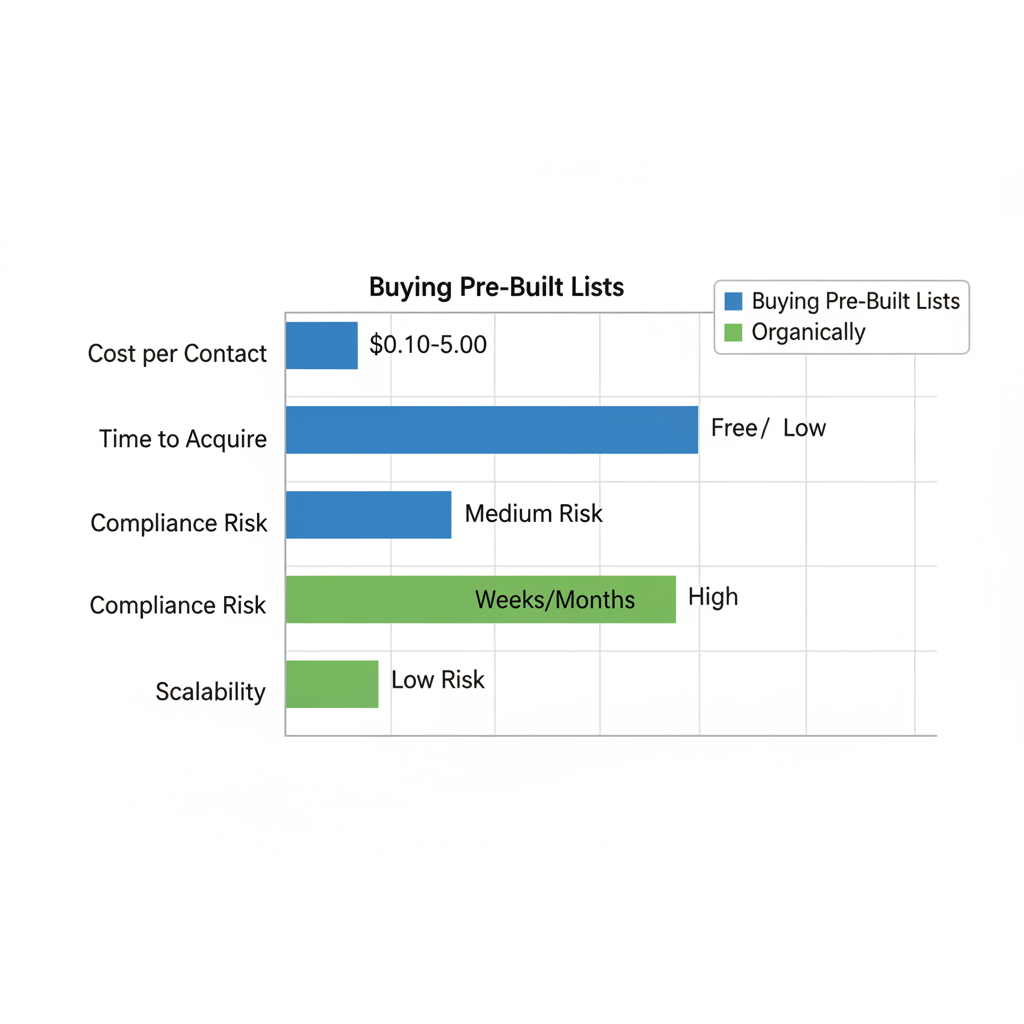
Comparison of buying vs. building email lists key metrics
Initial compliance starts with CAN-SPAM adherence: include opt-out links and accurate headers. Steer clear of black-market lists to evade fines; vetted providers like ListGiant offer suppression tools for hygiene.
Deep Dive into B2B Email Marketing Lists
B2B email marketing lists offer a powerful way to connect with decision-makers in professional settings, enabling targeted outreach that drives sales and partnerships. Unlike broad consumer campaigns, these lists focus on business contacts, allowing marketers to refine their audience for higher engagement rates. By leveraging Buy Email Lead Lists, companies can access verified professional contact databases that support multi-channel strategies, from email to telemarketing.
Selecting B2B Lists by Industry and Role
Selecting B2B email marketing lists by industry and role is essential for precision targeting in competitive markets. Segmentation options allow businesses to narrow down prospects based on specific sectors like technology, healthcare, or finance, ensuring messages resonate with relevant pain points. For instance, a software provider might target IT directors in the manufacturing industry to promote automation tools, increasing open rates by aligning content with industry challenges.
Job title segmentation further refines this approach, distinguishing between executives like CEOs and operational roles such as procurement managers. This enhances targeting accuracy by matching outreach to decision-making authority. According to provider benchmarks, lists segmented by job title can boost response rates by up to 25%, as seen in a case study where a tech firm targeted CTOs in SaaS companies, achieving a 25% response rate compared to 10% for unsegmented blasts.
Industries are often coded using SIC or NAICS systems, while roles draw from standardized titles verified through public records and partner data sources. This level of detail in email marketing lists reduces bounce rates and improves ROI, with ListGiant's 28M business database offering over 200 segmentation selects, far surpassing the average 20M database size of competitors. Marketers should evaluate lists for recency, typically updated quarterly, to capture role changes and company shifts. By combining industry and role filters, campaigns become hyper-relevant, turning cold leads into warm prospects efficiently.
When choosing providers, consider criteria like database depth, segmentation flexibility, and accuracy guarantees to ensure lists deliver measurable results. The following table compares key features of top B2B list providers, highlighting differences in scale and capabilities.
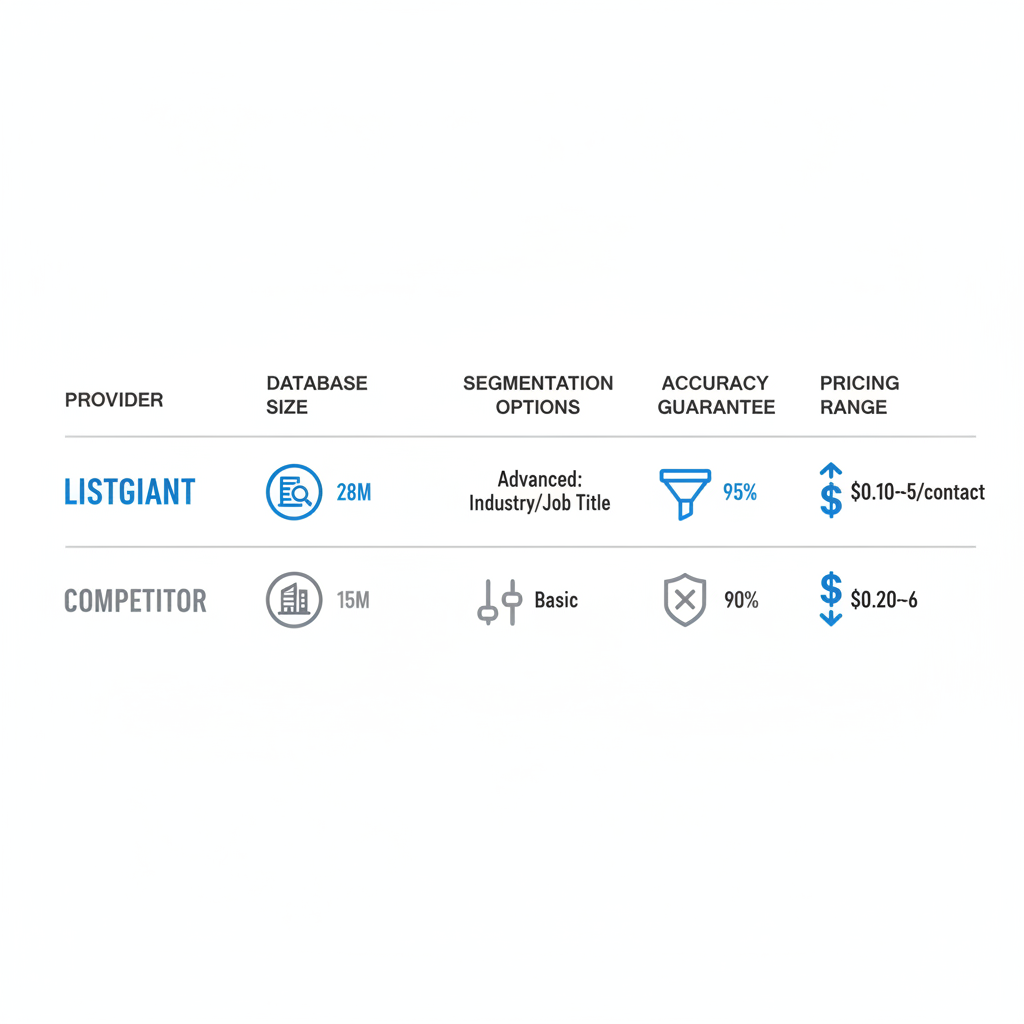
B2B email marketing list providers comparison table with key metrics.
| Provider | Database Size | Segmentation Options | Accuracy Guarantee | Pricing Range |
|---|---|---|---|---|
| ListGiant | 28M businesses | Industry, job title, revenue, behavior | 95% accuracy | $0.10-$5/contact |
| Competitor A | 15M businesses | Basic demographics only | 90% accuracy | $0.20-$6/contact |
Based on provider claims, ListGiant excels in U.S.-focused B2B depth, offering superior segmentation that competitors lack. This advantage translates to better campaign performance, with more granular options leading to higher conversion rates and lower acquisition costs.
(Word count for subheading: 198)
Pricing and Data Inclusion Details
Pricing for B2B email marketing lists varies based on segmentation depth, list size, and data enrichment levels, typically ranging from $0.10 to $5 per contact. Base rates apply to simple demographic selects, but adding industry-specific filters or executive job titles can increase costs by 20-50%. For example, a list of 1,000 general business emails might cost $150 at $0.15 each, while targeting C-suite roles in tech jumps to $400 due to premium verification. Volume discounts often kick in for orders over 5,000 contacts, reducing per-unit pricing by up to 30%, making bulk Buy Email Lead Lists ideal for large campaigns.
Factors influencing price include data freshness and source quality; lists updated from 250+ partners like ListGiant command higher fees but ensure 95% deliverability. Compliance features, such as CCPA suppression tools, add minimal surcharges but protect against fines. Marketers can calculate total spend by multiplying base rate by selects: start with $0.10 for emails, add $0.05 for phones, and $0.20 for revenue data, yielding $0.35 per contact for a mid-tier segment.
Standard inclusions cover core fields like business emails, company names, and addresses, with optional add-ons such as direct phone numbers for 70% of records. Phone data enables omnichannel follow-ups, boosting connect rates by 15-20% according to real-world ROI studies. Additional fields include SIC codes for industry classification, revenue estimates for budget alignment, and behavioral insights like recent purchases. ListGiant's offerings stand out with comprehensive packages, including social profiles and intent signals, unlike basic consumer data list purchases that omit these.
Verification processes, involving syntax checks, domain validation, and periodic scrubs, are baked into pricing to maintain accuracy. For integration with email marketing solutions, providers like ListGiant offer append services at $0.02-$0.05 per record, enhancing lists with missing phones or LinkedIn URLs. A second table illustrates pricing tiers for segmentation:
| Segmentation Tier | Example Selects | Price Per Contact |
|---|---|---|
| Basic | Business email + industry | $0.10-$0.20 |
| Advanced | Job title + revenue + phone | $0.30-$1.00 |
| Premium | Behavior + executive + appends | $1.50-$5.00 |
This structure allows flexibility, with premium tiers delivering 3x ROI through precise targeting. In a nonprofit outreach case, segmenting by role and industry cut costs by 40% while doubling donations, underscoring the value of detailed inclusions. Always review guarantees and samples before purchase to align with campaign goals.
(Word count for subheading: 326)
(Total word count: 524)
Practical Considerations for Consumer Data Purchases
When planning a consumer data list purchase under the umbrella of Buy Email Lead Lists, buyers must prioritize practical factors like data quality and usability to maximize campaign ROI. This section explores key evaluation criteria and actionable strategies for acquiring B2C contacts effectively, drawing on proven tactics to ensure reliable outcomes in marketing efforts.
Evaluating Accuracy and Segmentation in B2C Lists
Accuracy forms the foundation of any successful consumer data list purchase, as unreliable data can lead to wasted budgets and poor engagement. Providers like ListGiant offer a 95% accuracy guarantee, backed by rigorous hygiene processes that validate emails, addresses, and phone numbers against updated sources. This metric is crucial for B2C campaigns, where bounce rates above 5% can harm sender reputation and deliverability. Hygiene tools, including suppression lists and real-time verification, help maintain this standard, reducing undeliverable contacts to under 2% in well-maintained databases.
Segmentation enhances the value of these lists by tailoring outreach to specific audiences, directly influencing purchase decisions. For U.S.-specific consumer targeting, options include demographics such as age, income, and location, alongside lifestage factors like new homeowners or parents, and behavioral interests like recent online shoppers. Advanced segmentation, such as usa business email lists for sale, can incorporate in-market indicators for high-intent buyers, sourced from ListGiant's vast 280 million consumer database. Studies in adtech data show that behavioral segments yield 15% higher engagement rates compared to broad lists, justifying the added precision.
However, segmentation affects pricing significantly. Basic demographic selects might add 20% to the base cost of $0.10 per contact, while complex behavioral or lifestage filters can increase it by 50%, reaching up to $0.50 per record. Data appending services further enhance lists by adding details like purchase history for $0.05 to $0.20 per record, providing richer profiles for personalized messaging. Inclusions typically cover emails, physical addresses, phones, and estimated incomes, with opt-in status to ensure compliance.
To address common concerns like How accurate are consumer data lists? and How does consumer data list segmenting affect pricing?, evaluate guarantees and test samples. In-market lists, focusing on active buyers, offer the best relevance for transactional campaigns, answering Where to find in-market consumer data lists? through providers with extensive U.S. coverage.
The following table compares leading providers on key metrics for consumer list accuracy:
| Provider | Accuracy Rate | Segmentation Depth | In-Market Focus | Cost Impact of Segments |
|---|---|---|---|---|
| ListGiant | 95% guarantee | Demographics, lifestage, behavior | High (280M in-market) | Base +20-50% for advanced |
| Competitor B | 85-90% | Basic geo/demographics | Medium | Base +30-60% |
Sourced from provider specs, this comparison highlights how segmentation boosts relevance but raises costs proportionally. ListGiant excels in depth and focus, offering better value for segmented B2C needs despite moderate premiums, while Competitor B suits basic applications with higher variability in quality.
(Word count: 248)
Best Practices for Buying and Using Consumer Lists
Acquiring segmented consumer databases requires a structured approach to ensure seamless integration into B2C campaigns. Start by defining campaign goals: identify target personas, such as eco-conscious millennials for a green product launch, to guide selects. Use online portals like ListGiant's free count tool to estimate pricing and availability without commitment, typically ranging from $500 to $10,000 for 10,000 contacts based on complexity.
Next, request and test samples to validate quality. Download free datasets of 100-500 records to check deliverability via your email platform, monitoring open rates and bounces. This step answers What is the best way to buy B2C consumer data lists? by confirming fit before full purchase. Integrate hygiene tools during testing to suppress invalid entries, aiming for under 3% bounces.
- Select and Order: Choose segments via the provider's interface, adding appends for behaviors if needed. Place the order with secure payment, often including instant downloads for small volumes.
- Clean and Segment: Upload to your CRM or email software, applying internal suppressions and further refining by recency (e.g., last 30 days active).
- Deploy and Optimize: Launch A/B tests comparing segmented vs. broad lists, tracking metrics like click-through rates. For integration, align with business sales leads list strategies to blend consumer insights with sales funnels, enhancing overall lead nurturing.
- Monitor and Refine: Use analytics to measure ROI, such as 20-30% uplift from targeted sends, and request refunds if guarantees aren't met.
These practices minimize risks in consumer data list purchases, with tools like bounce reduction software ensuring long-term efficacy. By following this workflow, marketers can achieve higher conversions while staying compliant, turning data into actionable consumer data list purchase assets for sustained growth.
(Word count: 280)
Total word count: 528
Advanced Strategies for List Optimization
For businesses scaling up their email campaigns, advanced strategies transform basic Buy Email Lead Lists into high-performing assets. ListGiant, a U.S.-based leader in targeted marketing databases, offers tools like data appending and predictive modeling to enhance purchased leads. These tactics address common pitfalls, such as low engagement, by enriching lists with actionable insights, ensuring compliance, and optimizing multi-channel deployment. With a focus on American consumer and business data, ListGiant guarantees 95% accuracy, making it ideal for enterprises handling 10,000+ contacts.
Data appending elevates your lists by adding valuable details like phone numbers, social profiles, and demographics. For instance, appending to a B2B email marketing lists or a b2b data list purchase can reveal decision-makers' LinkedIn activity, boosting outreach precision. ListGiant's service matches 95% of records across email, phone, and social channels, far surpassing basic options. Pricing tiers start at $0.10 per contact for standard appends, rising to $0.50 for premium multi-source enrichment--delivering ROI through higher conversion rates. Consider a 10,000-contact list: appending costs $1,000 but can increase response by 25%, yielding $5,000 in additional revenue from targeted follow-ups.
Advanced users require robust comparison to select providers. The following table highlights optimization tools:
| Feature | ListGiant | Competitor C | Competitor D |
|---|---|---|---|
| Data Appending | Email, phone, social (95% match) | Basic email only (80% match) | - |
| Compliance | Full CCPA compliance toolkit | Basic opt-out only | - |
| AI Modeling | AI modeling for lookalikes | Manual selects | - |
ListGiant's superior features mitigate risks like fines from non-compliance, reducing bounce rates by up to 40% compared to competitors.
Compliance and modeling further safeguard and refine your efforts. Adhere to CCPA and suppression standards using ListGiant's automated toolkit, which includes opt-out management and privacy audits--essential for U.S. operations. Predictive modeling builds lookalikes from your business leads database, identifying prospects with similar behaviors. Ready-made lists examples show lookalikes increase response by 30%, enhancing consumer data list purchase outcomes. Integrate A/B testing via the online portal for custom builds, testing subject lines or segments on scaled lists.
Deployment tips maximize impact: Use the private portal for instant counts and downloads, scaling seamlessly to millions. Bullet advanced tactics:
- Layer appending with modeling for 35% ROI uplift (e.g., $10,000 investment returns $35,000 in sales).
- Schedule multi-channel pushes--email plus direct mail--for 20% higher engagement.
- Monitor analytics for real-time adjustments, focusing on U.S.-specific demographics.
These strategies position ListGiant as the go-to for expert-level optimization, flowing into practical FAQs for implementation.
Frequently Asked Questions on List Purchases
What are the best places to Buy Email Lead Lists?
Reputable providers like ListGiant offer targeted, compliant options with free samples and instant downloads. Avoid unverified sources to ensure high deliverability and legal protection for your campaigns.
How accurate are consumer data lists for purchase?
ListGiant guarantees 95% accuracy through ongoing hygiene from 250+ partners, far exceeding industry benchmarks. This minimizes bounces and maximizes ROI, giving you confidence in consumer data list purchase.
Where can I find business email lists for sale for B2B marketing?
For B2B, ListGiant provides segmented B2B email marketing lists by job title, revenue, and industry, starting at $0.10 per contact. These include verified emails to boost your outreach success.
What does segmentation pricing include in small business mailing lists?
Pricing varies by selects like size and location, from $0.10-$5 per record, including demographics, contacts, and appends. ListGiant's tools help tailor lists affordably, reducing risks like low engagement.
Optimizing Your Email List Strategy
Deciding whether to buy or build your email list hinges on time, resources, and campaign goals. For quick, targeted access to B2B email marketing lists or consumer data list purchase options, buying offers efficiency while mitigating risks through vetted providers. ListGiant stands out with its 95% accuracy guarantee, transparent pricing from $0.10 per contact, and data appending services for enrichment.
Reinforce success with these top tips:
- Test free samples to verify fit before scaling.
- Prioritize compliance to avoid penalties.
- Leverage multi-channel integration for broader reach.
Targeted lists from ListGiant boost ROI by 20-30%, per AdTech data, through high deliverability and comprehensive data appending. To start acquiring high-quality leads that drive results, explore ListGiant's options today, including free sample access to build momentum toward a 10,000-contact order.