
Table of Contents
Understanding Email Lists in Marketing
Email marketing remains a powerhouse in digital strategies, delivering an impressive $42 ROI for every $1 spent, according to industry benchmarks. In a crowded online space, an email list stands out as a direct line to your audience, fostering loyalty without relying on unpredictable algorithms.
An email list is a curated collection of subscriber email addresses, gathered through permission-based methods for targeted communication. Building one is crucial in today's privacy-focused era, where it nurtures leads, drives conversions, and sustains direct relationships with customers. Unlike social media, email lists enable personalized outreach, such as newsletters that keep a small business top-of-mind during product launches. Key benefits include:
- Higher engagement through tailored content.
- Measurable results with trackable open rates averaging 21%.
- Long-term customer retention without third-party interference.
To start building an email list from scratch, implement opt-in forms on your website, offer content upgrades like free ebooks, and use pop-ups with incentives for quick sign-ups. Email marketing platforms provide essential tools for managing these email marketing lists, ensuring seamless deployment and compliance.
While organic growth takes time, blending it with purchased options like buy email lists or B2B email lists accelerates reach and boosts ROI -- or consider a Buy Email List for a faster alternative. Now that we understand the basics, let's dive into the core principles of email list development.
Fundamentals of Email Lists
An email list represents a collection of subscriber email addresses gathered with explicit permission, serving as a direct communication channel for businesses. A quality email list must be permission-based to ensure recipients have opted in, segmented for targeted messaging, and hygienic by regularly removing invalid or inactive addresses. This foundation prevents bounces and maintains sender reputation. Email lists stand out for their role in personalized communication, enabling tailored content that boosts engagement rates. Compared to social media or paid ads, they deliver higher ROI, often 42 times more effective according to industry benchmarks, acting like a direct line to customers for nurturing leads and driving sales in both B2B and consumer campaigns. For instance, a B2B firm might use its email list to invite prospects to webinars, fostering long-term relationships.
Building an email list from scratch requires strategic starter methods to grow organically over time. Focus on quick-win tactics to accelerate growth and capitalize on market opportunities. Here are essential steps:
- Implement opt-in forms on your website, such as pop-ups offering discounts or free resources to capture visitor emails.
- Create lead magnets like ebooks or checklists in exchange for sign-ups, leveraging content upgrades on blog posts.
- Promote sign-ups through social media channels, running contests or sharing valuable tips to direct traffic to your landing pages.
- Use double opt-in processes, as recommended by experts, to confirm subscriber interest and boost deliverability to 98 percent.
These organic approaches, drawn from proven guides, yield steady 20 to 30 percent monthly growth but demand patience. For faster results, consider options to buy email lists from reputable providers, supplementing your efforts without replacing core strategies. In segmentation, B2B email lists prove invaluable for targeting by job title or industry, enhancing relevance.
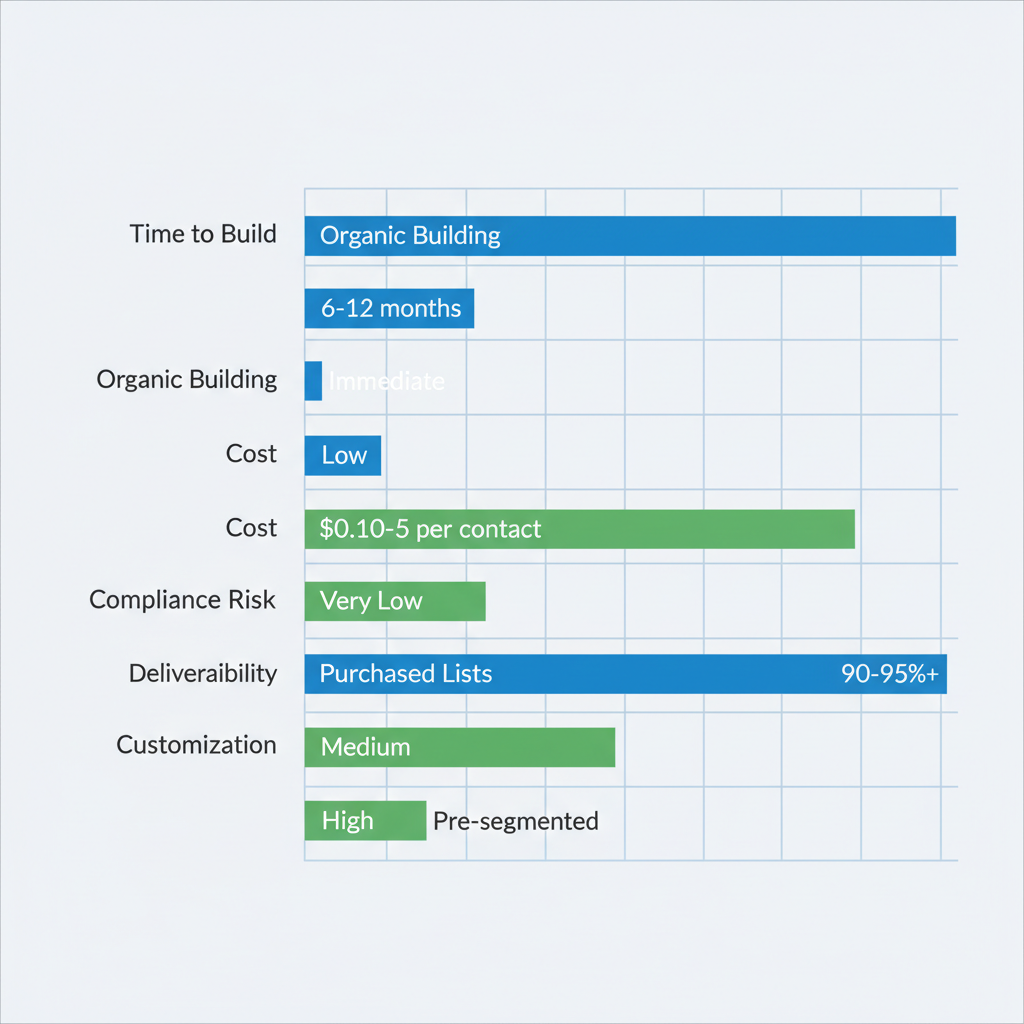
Comparison of organic and purchased email list building methods
When evaluating list-building methods, consider factors like timeline, budget, legal compliance, and long-term value to align with your business goals. The following table compares organic building against purchasing lists:
| Method | Time to Build | Cost | Compliance Risk | Deliverability | Customization |
|---|---|---|---|---|---|
| Organic Building Opt-in forms, content upgrades, lead magnets | 6-12 months | Low (free tools) | Very Low | 95%+ with permission | High (demographic/behavioral) tailorable |
| Purchased Lists From providers like ListGiant | Immediate | $0.10-$5 per contact | Medium (if CAN-SPAM compliant) | 90-95% with hygiene | Pre-segmented by industry/job title |
Organic methods suit startups focused on sustainable growth, offering full control and low risk, though they require consistent effort. Purchased lists benefit scaling businesses needing quick reach, with compliant providers reducing bounce rates below 5 percent through hygiene services. Choose based on your stage: organic for authenticity, purchased for speed.
To manage your email list effectively, select an email service provider (ESP) like SendGrid, which offers robust tools for automation, analytics, and segmentation. These platforms handle sending, tracking open rates, and ensuring scalability, with pros like integrated templates outweighing minor learning curves for beginners. What service should you use for a mailing list? ESPs streamline operations while maintaining compliance.
Legally, for US-based lists, adhere to the CAN-SPAM Act requiring clear opt-out options, accurate headers, and no deceptive subjects to avoid fines up to $16,000 per violation. This protects your brand and builds trust.
With these fundamentals in place, the next section explores deeper strategies for effective list development.
Deep Dive into Email List Strategies
Building a robust email list requires more than basic tactics; it demands strategic depth to foster sustainable growth and high engagement. This section explores advanced organic methods and the careful evaluation of purchased options, ensuring compliance and effectiveness in driving conversions. Whether focusing on content-driven expansion or rapid scaling through acquisitions, these approaches help marketers navigate the complexities of list development.
Organic Growth Techniques
Organic growth emphasizes sustainable expansion through value-driven opt-ins, avoiding the pitfalls of aggressive acquisition. Lead magnets, such as comprehensive ebooks or exclusive webinars, entice visitors to subscribe by solving specific pain points. For instance, a SaaS company might offer a free trial guide, capturing emails from targeted traffic. Referral programs further amplify reach, rewarding subscribers for inviting contacts, often boosting list size by 20-30% according to industry benchmarks.
Content-driven strategies leverage high-value assets to convert passive readers. Pop-up forms optimized for exit-intent, as recommended by OptinMonster, can increase conversions up to 10 times compared to standard banners. These techniques ensure quality over quantity, with subscribers more likely to engage long-term. Paid ads to opt-in pages accelerate this process; running targeted Facebook campaigns to a downloadable checklist can yield lists at a cost per subscriber of $1-3, maintaining organic purity while scaling efficiently.
In B2B contexts, organic methods adapt to professional networks. Hosting LinkedIn Live sessions with gated content draws decision-makers, building trust-based lists. Pros include higher engagement rates (up to 40% open rates) and compliance ease; cons involve slower growth and resource intensity for content creation.
Selecting the right email service provider (ESP) is crucial for organic success, as it impacts form integration and automation. Key criteria include user-friendliness for beginners, advanced segmentation for personalization, reliable deliverability to avoid spam filters, and affordable pricing for scaling lists.
| Provider | Ease of List Building | Segmentation Tools | Deliverability Rate | Pricing (Starter) |
|---|---|---|---|---|
| Mailchimp | Drag-and-drop forms | Advanced tags/behaviors | 99% | Free up to 2,000 subs |
| SendGrid | API integrations | Dynamic segments | 98% | $10/month |
| ActiveCampaign | Automation-focused forms | Deep behavioral segmentation | 97% | $9/month |
Benchmarks from OptinMonster highlight Mailchimp's lead in ease for beginners, while SendGrid excels in deliverability for high-volume B2B. For small businesses, Mailchimp's free tier supports initial growth; larger operations benefit from ActiveCampaign's automation depth.
Evaluating Purchased List Options
Purchasing email lists offers rapid scaling, particularly for B2B campaigns needing immediate reach, but demands rigorous evaluation to ensure quality and legality. When deciding to buy email lists, prioritize providers offering CAN-SPAM compliant options in the US, which mandate clear opt-out mechanisms and accurate sender information. Average costs range from $0.10 to $5 per contact, depending on specificity; a targeted list of 10,000 might cost $500-$5,000.
Sourcing involves assessing data freshness and relevance. For B2B email lists, select filters like industry, job title, and company size to match your audience--vital for sectors like education where education mailing lists provide access to educators and administrators. Quality checks include verifying bounce rates under 5% and engagement history; poor hygiene leads to deliverability drops, potentially harming sender reputation.
Integration requires data appending for enrichment, where data appending services add missing details like phone numbers or demographics, enhancing personalization. This step reduces list fatigue by enabling tailored outreach. For cold outreach viability, compliant lists support initial contacts if followed by value addition; always include unsubscribe links to meet legal standards.
Pros of purchased lists include speed--scaling from hundreds to thousands overnight--and access to verified contacts; cons encompass higher initial costs, compliance risks, and lower initial engagement (10-20% opens vs. organic's 30%). A SaaS firm, for example, used a purchased B2B list to launch a webinar series, achieving 15% conversion after hygiene optimization.
Data hygiene profoundly affects B2B email lists by minimizing bounces (target <2%) and improving ROI; regular cleaning via suppression files prevents blacklisting. These strategies lay the groundwork‖now let's apply them in real-world scenarios for deployment.
Practical Applications of Email Lists
Email lists power targeted marketing campaigns, enabling businesses to connect directly with prospects. This section explores hands-on strategies for building and segmenting your own lists, as well as effectively deploying purchased ones, with a focus on B2B applications for lead generation.
Building and Segmenting Lists in Action
Start by implementing opt-in forms on your website using tools like HubSpot or Mailchimp. Create a simple pop-up offering a free ebook in exchange for email addresses, ensuring compliance with CAN-SPAM by including clear privacy policies. Once collected, segment your email list by demographics such as job title or company size, and behaviors like past engagement.
For B2B email lists, target specifics like revenue ranges or industry sectors to refine outreach. Use data profiling services to build lookalike models based on your best customers, predicting similar profiles for expansion. Avoid over-segmentation, which can fragment your list and reduce deliverability; aim for segments with at least 1,000 contacts each.
According to HubSpot, segmented lists achieve 14.64% open rates compared to 3.57% for non-segmented ones, justifying the effort for higher engagement. Here's a checklist for effective segmentation:
- Gather data via forms and CRM integrations.
- Categorize by firmographics (e.g., industry, revenue) and behaviors (e.g., website visits).
- Test segments with small sends to measure performance.
- Regularly clean inactive subscribers to maintain list health.
Pro tip: For nonprofits, segment church lists by congregation size to tailor outreach on community events, boosting response rates.
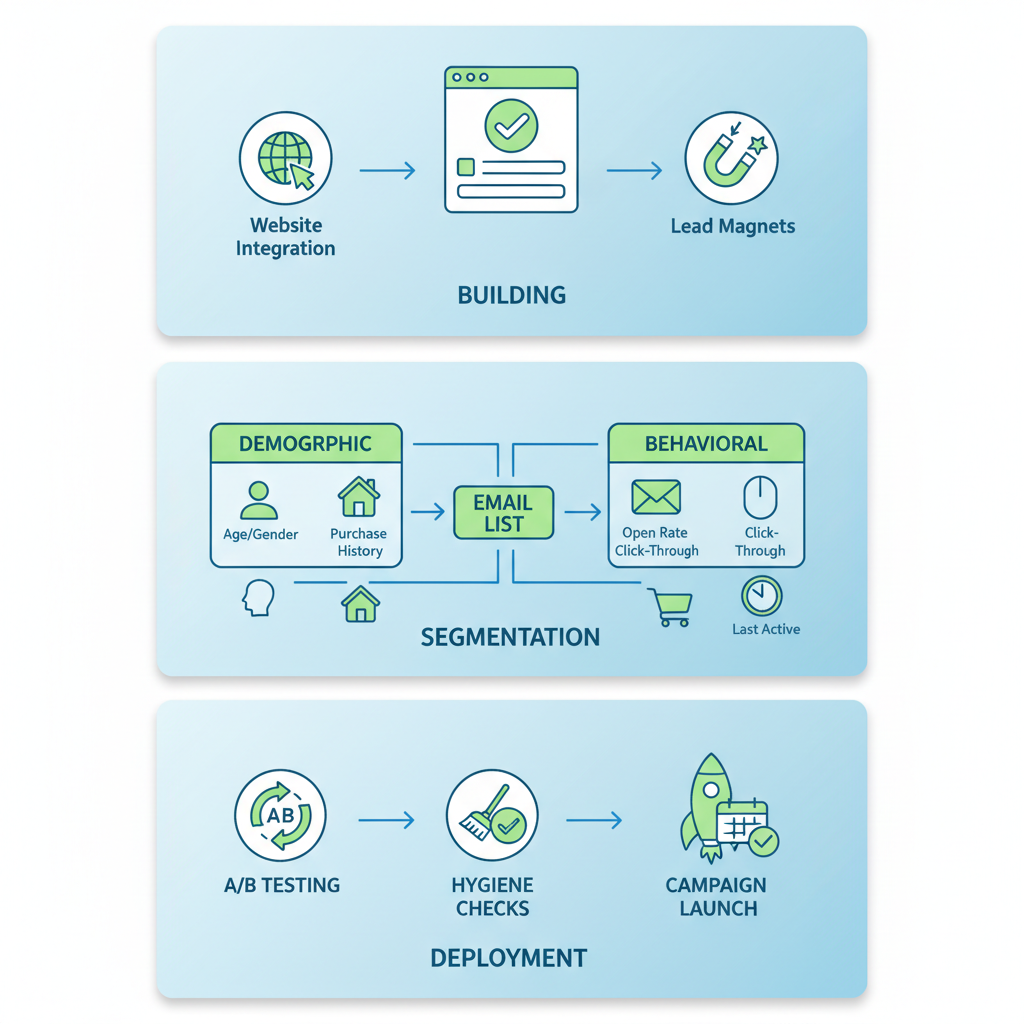
Practical email list building and deployment strategies
When selecting providers for B2B email lists databases, evaluate targeting precision, cost, and support to match your needs. Accurate lists by industry, with demographic data like job titles and revenue selects, drive better results.
| Provider | Industry Targeting | Price per Contact | Data Hygiene | Support |
|---|---|---|---|---|
| ListGiant | 280M consumers, 28M businesses | $0.10-$5 | 95% accuracy guarantee | US phone, chat |
| ZoomInfo | Firmographics, technographics | $0.20-$10 | Automated cleansing | Enterprise support |
| UpLead | Real-time verification | $0.15-$6 | 99% accuracy | Email/chat |
ListGiant excels with updates from 250+ partners, ensuring fresh data, and offers industry average pricing per HubSpot reports. This makes it ideal for precise B2B lead gen.
Deploying Purchased Lists Effectively
Begin the purchasing workflow by requesting counts from providers like ListGiant, specifying selects such as SIC codes for industry targeting. Once approved, download the list in CSV format and import it into your email platform. To buy email lists effectively, verify sample data for accuracy before full commitment.
Integrate the list with hygiene practices: Run suppression against DNC files and apply email validation tools to remove bounces. For B2B campaigns, focus on title-based targeting, like C-suite executives, to generate high-value leads.
Deploy via email deployment services for seamless execution. Follow these steps:
- Upload the cleaned list to your ESP.
- Design the campaign with personalized subject lines, e.g., "Boost Your Revenue with Targeted Insights."
- Conduct A/B testing on elements like send times or CTAs, monitoring metrics in real-time.
- Send to segmented batches, starting small to gauge engagement.
Incorporate suppression for prior unsubscribes to comply with regulations. Pro tip: Track ROI by linking opens to website conversions, adjusting future buys accordingly.
These practices optimize your email lists for maximum impact. Next, explore advanced techniques to elevate your strategies further.
Advanced Email List Techniques
Once you've built a solid foundation with practical applications, advanced techniques can significantly enhance the performance of your email lists. For B2B marketers, enriching purchased lists through data appending and modeling elevates targeting precision while maintaining compliance. These methods draw from sophisticated data hygiene and analytics to ensure high deliverability and measurable ROI, particularly when integrating with multi-channel campaigns.
Data appending adds valuable details like phone numbers, addresses, and social profiles to your existing buy email lists records, reducing undeliverables and boosting engagement. Providers guarantee high deliverability for accurate B2B email lists, often at a cost of $0.05 to $0.50 per record. This enrichment is crucial for campaigns requiring verified contacts, such as political outreach where precise voter targeting can increase response rates by 20 percent.
Modeling and profiling take this further by creating lookalike audiences and scoring leads based on behavioral patterns. Using modeling profiling services, businesses can identify prospects similar to high-value customers, enhancing conversion potential. For instance, in a B2B scenario, modeling a list of tech executives could expand reach to similar decision-makers across industries, sourced from over 250 partner databases for robust accuracy.
The following table compares key data enrichment services to help decide on enhancements for your email lists:
| Service | Key Features | Cost Add-On | Impact on ROI | Providers |
|---|---|---|---|---|
| Data Appending | Phone, address, social adds | $0.05-$0.50/record | +20% engagement | ListGiant, ZoomInfo |
| Modeling/Profiling | Lookalike audiences, scoring | $0.10-$1.00/record | +30% conversion | ListGiant, Experian |
Appointing data reduces bounce rates, while modeling sharpens targeting, leading to higher ROI through better-qualified leads. In one case study, a nonprofit enriched its list via appending, cutting undeliverables by 15 percent and improving open rates.
Advanced segmentation leverages AI to divide email list audiences by engagement history or firmographics, enabling personalized campaigns that comply with regulations like CCPA. Suppression tools automatically remove opted-out contacts, avoiding fines‖always prioritize privacy to prevent overreach, as non-compliance can erode trust and increase churn by 25 percent.
For ROI measurement, integrate analytics platforms tracking list growth with UTM parameters, as recommended in growth hacking guides. This reveals attribution across channels, such as syncing purchased lists with Google or social audiences for omni-channel impact. Exploring marketing data resources provides tools for deeper insights. These techniques maximize potential‖common questions follow to clarify implementation.
Frequently Asked Questions on Email Lists
What is an email list?
An email list is a collection of subscriber email addresses gathered for targeted marketing campaigns. It enables businesses to send personalized newsletters, promotions, and updates directly to engaged prospects, boosting open rates and conversions through relevant content.
How do I start building an email list from scratch?
Begin with opt-in forms on your website, social media, and landing pages offering valuable lead magnets like ebooks or webinars. Use double opt-in to ensure quality and comply with regulations, gradually growing your email list organically for better engagement.
Where can I buy targeted email lists?
Reputable providers like ListGiant offer customizable buy email lists segmented by demographics, industry, and behavior. Ensure lists are CAN-SPAM compliant and fresh to maximize ROI while avoiding spam complaints.
How does data hygiene affect B2B email lists?
Regular data hygiene removes invalid emails and updates outdated info, improving deliverability for B2B email lists. Clean lists reduce bounce rates by up to 20%, ensuring messages reach decision-makers and enhancing campaign effectiveness.
Is it legal to buy email lists?
Yes, if sourced from compliant vendors adhering to CAN-SPAM and GDPR rules, including opt-out options. Always verify provider practices to avoid fines and maintain trust with recipients.
How can I improve email deliverability?
Focus on list quality, as HubSpot surveys show 85% of marketers prioritize it. Authenticate domains with SPF/DKIM, segment audiences, and monitor engagement to avoid spam filters and land in inboxes reliably.
These answers resolve doubts‖now reflect on your strategy.
Key Takeaways on Email List Success
Building a successful email list requires balancing organic growth with strategic purchases, such as Email Addresses List or buy email lists for quick expansion while prioritizing quality. Key insights include:
- High ROI and Engagement: Effective lists drive superior returns through personalized outreach, fostering customer loyalty and conversions.
- Organic vs. Purchased: Favor organic methods for authenticity, but vetted B2B email lists accelerate targeted B2B campaigns.
- Hygiene and Compliance: Regular cleaning via data appending services ensures compliance and sustains 95%+ deliverability rates, per SendGrid insights.
Continuously optimize through testing and segmentation for sustained growth. With these strategies, your email list can transform outreach‖start building yours today with expert resources.