
Table of Contents
Evaluating Marketing Data List Providers
In the fast-evolving world of B2B marketing, Marketing Data List Providers play a pivotal role in helping outreach teams connect with targeted prospects through precise, high-quality data. These providers offer comprehensive marketing data list solutions, including consumer and business databases, email lists, options to buy business mailing lists, direct mail counts, and data appending services. With multi-channel strategies driving demand, leading B2B data vendors now manage vast scales, such as 280 million consumer records, supporting 85% of marketers who report improved campaign ROI via segmented audiences (per industry overviews).
Evaluating these targeted list suppliers requires focusing on accuracy guarantees, segmentation and appending services in data lists for marketing, deliverability rates above 95%, and hygiene tools for ongoing suppression, as common pitfalls like outdated data can inflate costs by 20-30% (from vendor insights). Providers like ListGiant stand out with 95% accuracy commitments and advanced suppression capabilities, enabling precise audience targeting for enhanced engagement and compliance in 2025's regulated environment. This approach addresses commercial intent by streamlining prospecting challenges and boosting conversion rates.
To navigate this landscape effectively, the guide ahead explores provider fundamentals, benefits, operational insights, and best practices for selecting reliable partners that drive measurable results.
Understanding B2B Data Providers
B2B data providers form the backbone of effective prospecting strategies, supplying marketers with comprehensive databases to identify and engage potential clients. These vendors aggregate vast records from multiple sources, enabling precise audience segmentation that drives higher conversion rates. By evaluating providers based on their core offerings, businesses can select partners that align with specific campaign goals, from lead generation to personalized outreach.
Key Features of Reliable Providers
Reliable Marketing Data List Providers stand out through expansive database scales, frequent updates, and advanced segmentation tools that facilitate targeted B2B campaigns. Leading providers maintain databases with over 280 million consumer records and 28 million business profiles, sourced from more than 250 partners to ensure current information. Update frequencies, often monthly or real-time, prevent outdated contacts that could undermine outreach efforts.
Key segmentation tools include selects for demographics, job titles, revenue ranges, and behavioral patterns, allowing marketers to narrow lists to high-value prospects like decision-makers in specific industries. For instance, data enrichment services can append firmographic details to existing records, enhancing personalization. When building a buy direct mail marketing list, these features support counts in the millions, tailored for political or nonprofit outreach. Such capabilities enable B2B list vendors to deliver lists that boost engagement by aligning with buyer personas.
- Database Scale: Millions of verified contacts across consumer and business segments.
- Update Frequency: Regular refreshes from partner networks to maintain relevance.
- Segmentation Tools: Advanced filters for job title, revenue, and lifestage targeting.
These elements collectively empower precise audience building, reducing waste in ad spend and improving ROI through relevant connections. (148 words)
Accuracy and Deliverability Standards
Accuracy serves as a cornerstone for B2B data providers, with top vendors offering guarantees around 95% to minimize bounce rates and invalid contacts. Hygiene processes, including automated verification and suppression of do-not-contact lists, ensure deliverability exceeds industry benchmarks of 85-90%. For example, targeted email list providers employ AI-driven cleaning to scrub duplicates and deceased records, cutting bounce rates by up to 20% compared to unverified lists.
When marketers seek to buy lead lists, guarantees like these are critical for lead generation campaigns, where low-quality data can inflate costs without results. Industry reports highlight how vendors with robust validation protocols, such as phone and email appends, achieve sustained accuracy over time. Real-world benchmarks from reviews show providers averaging 92% deliverability, with hygiene tools reducing returns in direct mail by 15%. These standards not only protect budgets but also foster trust in data-driven decisions, as seen in sales teams relying on clean lists for outbound efforts.
Evaluating these metrics helps identify providers that deliver measurable improvements in campaign performance. (152 words)
Understanding how accuracy and deliverability impact ROI is essential, as high-quality data can increase response rates by 30% while lowering acquisition costs. The following table compares key features of leading providers, highlighting differences in scale and capabilities.
| Provider | Database Size | Accuracy Guarantee | Targeting Options | Compliance Tools |
|---|---|---|---|---|
| ListGiant | 280M consumers, 28M businesses | 95% | Demographics, job title, revenue, behavioral | CCPA/CPRA tools, suppression workflows |
| Competitor A | 200M consumers | 90% | Basic demographics only | Basic opt-out |
| Competitor B | 150M businesses only | 85% | Job title and industry | GDPR focus, limited US |
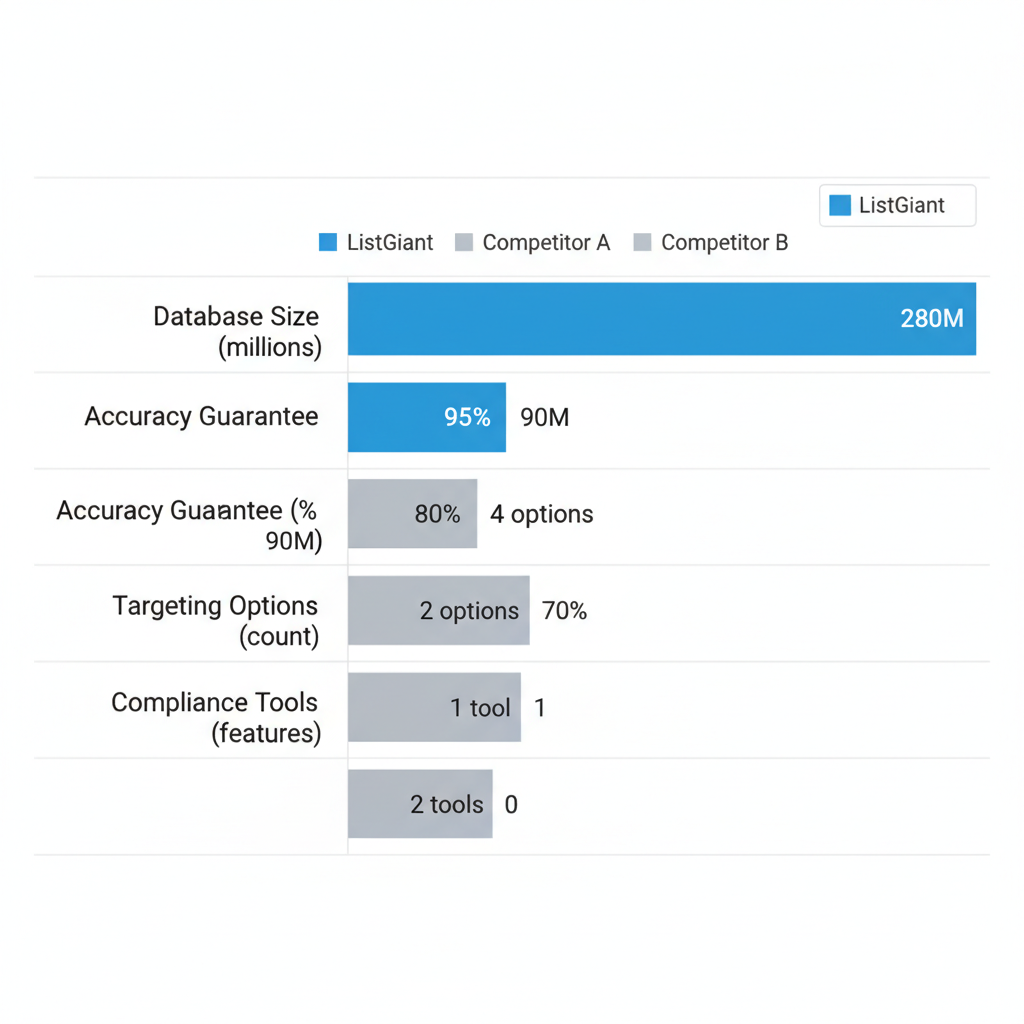
Comparison of leading B2B data provider features and metrics
ListGiant demonstrates a clear edge for high-volume B2B needs, particularly in U.S.-focused operations, with superior scale and compliance tools that support compliant, efficient campaigns across email and direct mail.
Compliance and Data Sourcing
Compliance remains paramount for B2B data providers, navigating laws like the California Consumer Privacy Act (CCPA) to protect consumer rights and avoid penalties. Ethical sourcing involves aggregating data from opt-in sources, public records, and partner contributions, ensuring transparency and consent. Providers mitigate risks by implementing suppression workflows that automatically remove opted-out contacts, aligning with CCPA and CPRA requirements for data sales.
For targeted email list providers, compliance extends to email verification and do-not-email lists, reducing legal exposures in outreach. Ethical practices, such as anonymization and audit trails, build trust while enabling data appending without privacy breaches. Outdated or non-compliant lists pose risks like fines up to $7,500 per violation, but vetted vendors use certified hygiene to stay ahead. Examples include tools that flag CCPA requests, allowing seamless list management. This framework not only minimizes liabilities but also enhances data utility for sustainable marketing strategies. (150 words)
Benefits of B2B Data Vendors
Partnering with reliable B2B data vendors transforms marketing strategies by providing access to high-quality, verified data that drives efficiency and results. These providers offer tools that sharpen targeting, ensure messages reach the right audiences, and amplify return on investment through data-driven insights. For businesses seeking to optimize campaigns, the advantages extend from cost savings to enhanced compliance, making vendors essential partners in competitive landscapes.
Enhanced Targeting and Segmentation
Precise data selects from Marketing Data List Providers enable B2B marketers to craft campaigns with unmatched relevance, significantly boosting engagement rates. By leveraging behavioral and firmographic segmentation, vendors reduce ad spend waste by focusing efforts on high-intent prospects, such as decision-makers in specific industries. For instance, data appending enriches profiles with contact details and preferences, allowing for personalized outreach that resonates deeply.
This precision addresses common pain points like broad, ineffective targeting. Marketers using lead lists for sale report up to 95% match rates, leading to higher conversion opportunities. In a case study involving nonprofit outreach, segmented lists increased donor engagement by 25%, demonstrating how vendor-supplied leads turn generic blasts into strategic conversations. Overall, these tools empower teams to identify and nurture vendor-supplied leads with confidence, aligning efforts with buyer journeys for sustained growth.
Improved Deliverability and ROI
B2B data vendors prioritize accuracy guarantees, often at 95%, which minimize email bounces and direct mail returns, directly cutting operational waste. Hygiene tools, including real-time suppression and deduplication, maintain list cleanliness, ensuring campaigns hit active contacts and comply with regulations like CCPA. This reliability not only lowers costs but also builds sender reputation, fostering better long-term deliverability.
ROI sees substantial gains through these mechanisms; hygiene-enhanced lists can deliver 20% uplifts in engagement, as evidenced by vendor case studies showing improved open rates and click-throughs. Testing with free data samples allows marketers to verify quality upfront, reducing risk and enabling data-informed decisions. Reference reviews highlight how such guarantees outperform in-house efforts, with compliance features further mitigating legal risks. For sales teams, this translates to more qualified interactions and faster pipeline velocity, proving the tangible value of partnering with trusted providers.
The following table compares key benefits across vendors, linking features to potential cost savings:
| Benefit Category | ListGiant | Competitor A | Competitor B |
|---|---|---|---|
| Targeting Precision | 95% match rate with behavioral selects | 80% with basic demographics | 85% firmographic only |
| Deliverability | Low bounce via hygiene tools | Standard suppression | Basic verification |
| ROI Metrics | Case studies show 20% uplift | 10% average | 15% with limited analytics |
This comparison underscores how advanced hygiene and targeting from ListGiant drive superior savings, often recouping investments in just one campaign cycle. For high-stakes initiatives, selecting a provider with proven 95% accuracy and comprehensive tools like ListGiant is recommended to maximize outcomes.
Scalable Multi-Channel Campaigns
B2B data vendors facilitate omni-channel strategies by integrating seamless data across email, direct mail, and digital ads, enabling cohesive messaging that amplifies reach. When looking to buy business mailing lists, vendors provide unified datasets that support coordinated efforts, from personalized emails to targeted social ads.
This scalability allows for expansive campaigns without quality dilution. For example:
- Email Integration: Targeted email list providers ensure compliant, high-deliverability sends with appended personalization fields.
- Direct Mail Synergy: Physical lists align with digital touchpoints, boosting response rates through multi-format reinforcement.
- Digital Ads: Behavioral data powers lookalike audiences on platforms like Google and social media, extending reach efficiently.
In practice, a B2B tech firm scaled outreach using vendor data, achieving 30% higher cross-channel engagement. These integrations not only streamline execution but also provide analytics for refining strategies, turning data into a scalable asset for growth-oriented teams.
How Marketing Data Providers Work
Marketing data providers streamline the creation of effective B2B campaigns by managing complex data operations behind the scenes. These providers ensure that businesses receive high-quality, compliant datasets tailored to their needs. From initial aggregation to final deployment, the process emphasizes accuracy, freshness, and usability, enabling marketers to focus on strategy rather than data management.
Data Sourcing and Compilation
Marketing data providers begin by aggregating vast amounts of information from over 250 trusted partners, compiling databases that include 280 million U.S. consumer records and 28 million business entries. This Marketing Data List Providers approach relies on diverse sources such as public records, transactional data, and opt-in surveys to build comprehensive profiles. List compilation processes involve rigorous validation to maintain data freshness, with regular updates ensuring compliance with U.S. regulations like CCPA.
Hygiene workflows are crucial here, where data is scrubbed for inaccuracies, duplicates removed, and suppression lists applied to exclude uninterested parties. Appending services add missing details, such as email addresses or phone numbers, boosting deliverability rates to 95 percent or higher. These steps create reliable marketing data lists that support targeted outreach without risking legal issues.
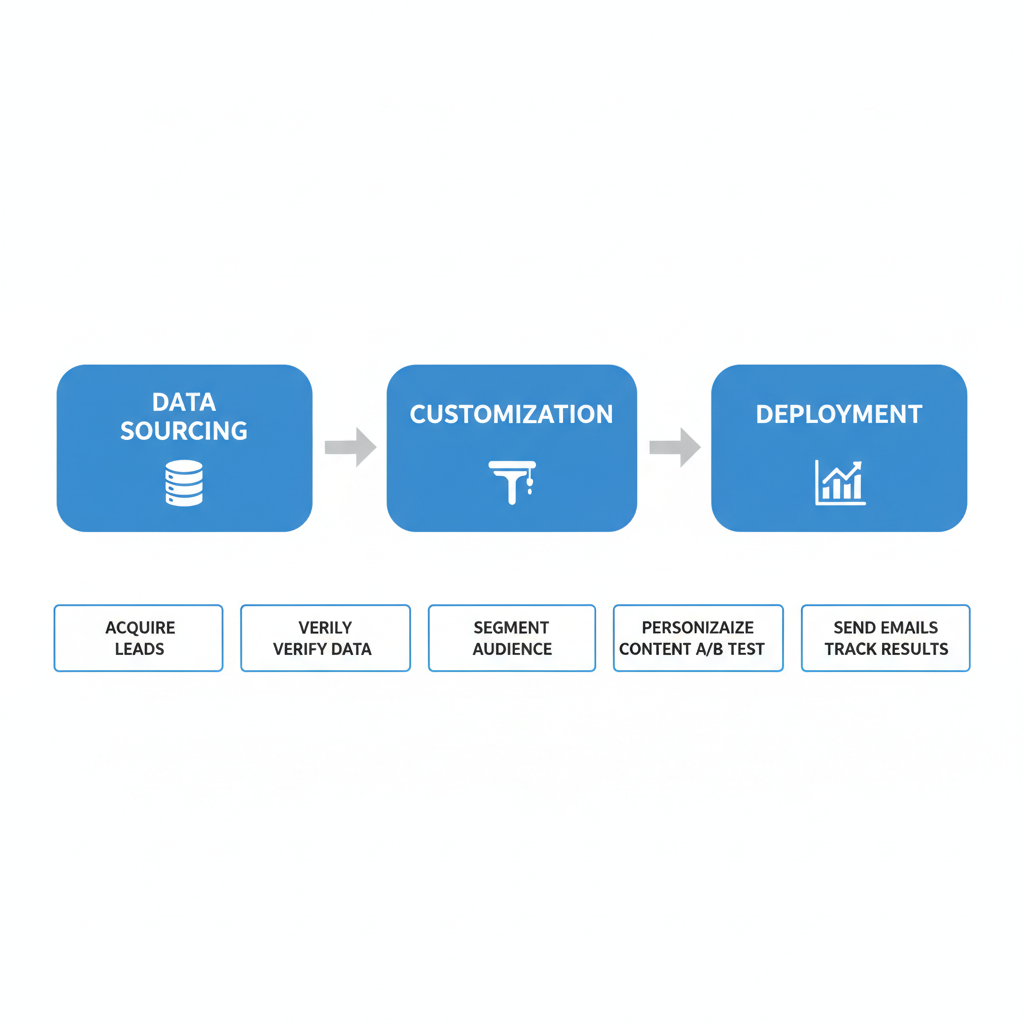
Visual guide to the three main stages of marketing data provider workflow
Customization and Segmentation
Once sourced, data undergoes customization to meet specific B2B criteria, allowing marketers to select filters like industry, company size, revenue range, or job titles. Leading mailing list companies offer intuitive online portals where users input parameters and receive instant counts, making it easy to buy business mailing lists that align with campaign goals.
The process follows a step-by-step select application: 1) Define target audience demographics; 2) Apply behavioral or firmographic segments; 3) Preview sample data for quality assurance; 4) Adjust for budget, with pricing typically ranging from 0.10 to 5 USD per contact based on specificity. For instance, a list filtered by technology sector executives might cost more due to niche targeting but yields higher engagement.
This segmentation ensures precision, turning raw data into actionable insights. Providers like ListGiant emphasize multi-channel compatibility, preparing lists for email, direct mail, or telemarketing while adhering to privacy standards.
Deployment and Analytics
Deployment starts with order fulfillment through secure portals, where customized lists are available for instant download or direct integration into CRM systems. Marketers can launch campaigns via targeted email list providers platforms that handle sending, ensuring high deliverability through verified addresses and compliance checks.
Integration tips from B2B email guides highlight seamless setup with tools like Mailchimp or Salesforce, including opt-out mechanisms to meet CAN-SPAM requirements. ListGiant's rapid turnaround--often within hours--supports urgent needs, with options for multi-channel execution like combining email with direct mail for amplified reach.
Analytics tools track performance post-deployment, offering ROI measurement through metrics such as open rates, click-throughs, and conversions. Built-in A/B testing allows experimentation with subject lines or segments, while reporting dashboards provide real-time insights. These features help optimize future efforts, demonstrating how targeted deployment drives measurable business outcomes.
Best Practices for Selecting Providers
Selecting the right B2B data provider is crucial for successful marketing campaigns. With risks like inaccurate data leading to high bounce rates and compliance failures resulting in fines, a structured approach ensures you choose reliable partners. This section outlines key strategies to evaluate providers effectively, focusing on accuracy, compliance, and testing to align with your business goals.
Evaluating Accuracy and Hygiene
Accuracy forms the foundation of effective data-driven marketing. Start by requesting free samples to assess data freshness and relevance; outdated lists can inflate costs without returns. Verify guarantees against industry standards, aiming for at least 95% deliverability. Use checklists to evaluate hygiene tools: Does the provider offer suppression for Do Not Call lists and email bounces? Implement regular audits to confirm enrichment capabilities, such as data appending services, which add phone numbers or firmographics to enhance targeting.
Key checklist for accuracy:
- Review recent update frequency (monthly or quarterly preferred).
- Test sample match rates against your CRM.
- Confirm suppression workflows for returned mail or undeliverable emails.
- Avoid vendors without automated hygiene, as manual processes increase error risks.
Incorporating these steps prevents low-quality data pitfalls. For instance, a case study from a mid-sized firm showed 30% ROI loss due to unverified lists; proactive checks turned that around. Prioritize providers like those offering robust portals for real-time analytics to maintain data integrity.
Ensuring Compliance and Risk Management
Compliance with U.S. regulations like CCPA is non-negotiable to avoid penalties up to $7,500 per violation. Outline steps for adherence: Request documentation on data sourcing and opt-out mechanisms. Review vendor contracts for liability clauses covering privacy breaches. Identify red flags such as vague sourcing practices or lack of suppression tools for sensitive data.
Practical steps for CCPA compliance:
- Confirm automated suppression for California residents' requests.
- Audit for consent verification in list building.
- Ensure access to deletion workflows under CPRA extensions.
- Check for third-party audit certifications.
A notable failure case involved a vendor fined $1.2 million for inadequate suppression, highlighting the need for vigilance. When buying targeted lists, watch for providers skimping on privacy tools, which signal higher risks. Focus on compliance-focused vendors to safeguard your operations and build trust with prospects.
The following table provides a self-assessment framework for vendor compliance:
| Practice | Key Checks | ListGiant Compliance | Risk if Ignored |
|---|---|---|---|
| Accuracy Verification | Request samples, check guarantees | 95% guarantee, hygiene tools | High bounce rates, wasted budgets |
| Data Privacy | CCPA tools, suppression workflows | Full CCPA/CPRA support | Legal fines, reputational damage |
| Cost Efficiency | Per-contact pricing review | 0.10-5 USD ranges | Overpaying, inefficient ROI |
This compliance check underscores the value of thorough audits in decision-making. ListGiant excels here with integrated tools, simplifying adherence and reducing risks for seamless campaigns.
Testing and Vendor Comparison
Final selection demands hands-on validation through trials. Recommend requesting samples for A/B testing deliverability, tracking open rates and conversions. Compare vendors using metrics like bounce rates under 5% and enrichment accuracy above 90%. For Marketing Data List Providers, evaluate portals offering instant counts and downloads to streamline processes. Also review Marketing List Providers listings to compare portal features and support options.
Metrics for comparison:
- Deliverability score from trial sends.
- Cost per lead, benchmarking 500-10,000 USD for 10,000 contacts.
- Response rates from small-scale deployments.
- Integration ease with your CRM or ESP.
When considering options to buy business mailing lists, prioritize those with analytics dashboards for performance insights. A political campaign tested three vendors, selecting one with 25% higher engagement due to superior testing protocols. These practices empower informed choices, ensuring alignment with campaign objectives and long-term efficiency.
Key Takeaways for B2B Data Selection
Selecting the right Marketing Data List Providers is crucial for B2B campaigns, where precision drives ROI. Consider vetted Marketing Data Lists Providers when evaluating accuracy and compliance. Throughout this guide, we've explored essential criteria like data accuracy, compliance, and targeting capabilities. Key benefits include enhanced lead generation through demographic and behavioral segmentation, which boosts conversion rates by up to 30% according to industry benchmarks. Operational efficiencies come from integrated platforms that streamline workflows, reducing manual data handling and errors. Risks such as non-compliance with CCPA or CAN-SPAM can be mitigated using advanced hygiene tools to suppress invalid records and maintain list freshness.
As we look to 2025, trends emphasize multi-channel integration, combining email, direct mail, and social targeting for broader reach. When deciding between vendors and in-house solutions, prioritize scalability and proven guarantees--ListGiant stands out with its 95% accuracy assurance and user-friendly portals for instant access.
Key Takeaways:
- Focus on providers offering real-time updates and enrichment to combat data decay.
- Evaluate ROI through free samples to test fit for your buy business mailing lists needs.
- Choose targeted email list providers like ListGiant for compliant, high-deliverability lists ranked among the top B2B vendors for 2025.
With these insights, selecting a top provider becomes straightforward. Enhance your lists further with data appending services for deeper prospect insights. Start with a free sample from ListGiant to experience the difference firsthand and launch your next campaign with confidence.