
Table of Contents
Understanding Marketing List Providers in the US
In today's competitive B2B landscape, Marketing List Providers in the US play a pivotal role in driving lead generation success, with studies showing that targeted campaigns can boost ROI by up to 30 percent through precise audience outreach. Businesses increasingly turn to these providers for high-quality databases to fuel email, direct mail, and multi-channel strategies.
Marketing list providers supply curated consumer and business databases for acquisition, enabling segmentation by demographics, job titles, and behaviors. As leading B2B data providers, they offer US email list suppliers that ensure compliant data under regulations like CAN-SPAM and CCPA. Key benefits include enhanced deliverability and personalized messaging, yet challenges such as low accuracy or outdated lists can lead to bounced emails and compliance risks. Over 95% of B2B marketers rely on purchased lists for lead generation, underscoring their essential value.
This guide explores the fundamentals of selecting reliable providers, from data sourcing to integration tactics. It covers evaluation criteria to help you identify top options:
- Accuracy guarantees and verification processes
- Pricing models, such as pay-per-lead or subscription tiers
- Multi-channel support for email, mail, and digital campaigns
By mastering these elements, businesses achieve better targeting and measurable results in prospecting efforts.
For acquisition options, explore lead lists for sale from trusted mailing list companies that specialize in targeted lead databases. Providers like ListGiant deliver US-focused capabilities, including a vast database of 280 million consumers and advanced hygiene tools for superior campaign performance and compliance.
Core Fundamentals of Marketing List Providers
Marketing List Providers in the US form the backbone of effective B2B campaigns, delivering reliable data for targeted outreach. These providers offer foundational services like data compilation, hygiene, and compliance tools to support lead generation. Understanding these basics helps businesses evaluate options for high-ROI marketing efforts, with typical databases covering 280 million consumers and 28 million businesses.
Key Components of Reliable Data Sources
Reliable data sources drive successful US campaigns by ensuring accuracy and relevance. Database size represents a core element, often spanning 280 million consumers and 28 million businesses, sourced from diverse partners to capture comprehensive market coverage. Update frequency maintains freshness, with leading providers refreshing records daily or weekly from over 250 partners to reflect real-time changes in contact information.
Data hygiene processes further enhance quality through suppression of invalid emails and appending of missing details like phone numbers. For instance, marketing data lists allow customization by integrating verified fields for better deliverability. According to industry reports on B2B providers, such practices boost campaign success rates by up to 40 percent.

Visual comparison of key fundamentals for marketing list providers
Fundamentals like these directly impact ROI by minimizing waste on outdated leads. The following table outlines differences between provider tiers:
| Aspect | Entry-Level Providers | Advanced Providers |
|---|---|---|
| Database Size | Typically 50-100M records | 200M+ consumers, 20M+ businesses |
| Update Frequency | Monthly or quarterly | Daily/weekly from 200+ partners |
| Compliance Tools | Basic suppression lists | Advanced hygiene, CCPA/CCPRA support, 95% accuracy guarantee |
Advanced providers, as ranked by top B2B evaluations, reduce bounce rates by 20-30 percent through superior tools, making them ideal for scaled operations.
Compliance Essentials for Email and Mail Lists
Compliance forms the legal foundation for using email and mail lists in B2B marketing. Key US regulations include CAN-SPAM, which mandates opt-out options and accurate headers for commercial emails, and CCPA, protecting consumer privacy by allowing data access and deletion requests.
Suppression tools play a vital role, removing do-not-contact records to avoid fines up to $43,792 per violation under CAN-SPAM. Providers offer automated hygiene to scrub lists against national suppression files.
- Start with opt-in verification for new contacts.
- Implement annual CCPA audits for California residents.
- Use deployment platforms for compliant sending.
For example, political outreach lists must adhere to these rules to prevent backlash. Email marketing solutions ensure seamless integration of compliance during campaign rollout, aligning with US B2B list fundamentals.
Basic Targeting Options Available
Basic targeting refines lists to match specific business needs, enhancing engagement in US campaigns. Demographic selects filter by age, income, or location, while firmographic criteria target by company size, revenue, or industry--such as focusing on firms with over $10 million in annual revenue.
Behavioral selects incorporate purchase history or website interactions for predictive outreach. Job title targeting, like executives in tech sectors, pairs well with these for precision. To acquire such lists, businesses can buy targeted email list options starting at 0.10 USD per contact, with costs rising to 5 USD for appended data.
Entry-level data providers suffice for broad casts, but advanced segmentation yields 25 percent higher response rates per purchase guidance sources. This builds toward multi-channel strategies, including email and direct mail, without complexity.
In-Depth Analysis of Provider Capabilities
When evaluating Marketing List Providers in the US, businesses must examine advanced features that elevate campaign precision and outcomes. This deep dive explores segmentation sophistication, omni-channel integration, and reliability metrics, drawing from industry standards to guide informed selections among top B2B data providers. By focusing on these elements, companies can identify suppliers that deliver high-quality leads while minimizing risks associated with outdated or non-compliant data.
Advanced Segmentation and Data Enrichment
Advanced segmentation forms the backbone of effective B2B marketing, allowing providers to slice audiences using firmographic details like company size and industry alongside behavioral signals such as purchase intent. Leading B2B data providers employ lookalike modeling to mirror high-value customers, creating profiles that predict future prospects with remarkable accuracy. For instance, enrichment services append critical data points, including email addresses, phone numbers, and social profiles, transforming basic lists into actionable intelligence.
In the US market, these capabilities shine through case studies from sources like the B2B Email List Guide, which highlight how appended data boosts engagement rates by up to 40% in targeted campaigns. Businesses can tailor segments by job titles, revenue thresholds, or even lifestage events, ensuring relevance for sectors like tech or healthcare. However, over-segmentation poses a pitfall, fragmenting lists and inflating costs without proportional returns.
The value of customization cannot be overstated, as it directly impacts lead quality and conversion potential. Consider the following comparison of segmentation features across key providers:
| Feature | Provider A (e.g., ListGiant) | Provider B | Provider C |
|---|---|---|---|
| Behavioral Selects | Job title, revenue, lifestage | Basic demographics only | Firmographics + intent |
| Data Appending | Email, phone, social | Limited to email | Full contact enrichment |
This table illustrates how Provider A excels in depth, offering robust options that support sophisticated strategies. Post-comparison, cost implications emerge: for a 10,000-contact order, advanced appending might range from 500 to 5,000 USD, depending on specificity, making it essential to balance depth with budget constraints. Such customizable marketing lists enable precise targeting, ultimately enhancing ROI through better-aligned outreach.
Multi-Channel Integration Options
Omni-channel strategies amplify reach by syncing data across email, direct mail, telemarketing, and digital platforms like Google and social media. Omni-channel data suppliers facilitate seamless transitions, allowing marketers to deploy consistent messaging whether via inbox, mailbox, or targeted ads. For example, targeted mailing lists integrate with digital audiences on Google and YouTube, enabling retargeting that captures prospects at multiple touchpoints.
Telemarketing counts add a personal layer, with providers supplying verified phone data for high-conversion calls, while social segments build lookalike audiences on platforms like LinkedIn or Facebook. This integration reduces silos, fostering cohesive campaigns that US businesses use to nurture leads from awareness to purchase. Drawing from over 250 data partners, firms like ListGiant ensure freshness across channels, supporting hybrid approaches that blend offline and online efforts.
Integration depth varies significantly, as shown in this provider comparison focused on multi-channel support:
| Feature | Provider A (e.g., ListGiant) | Provider B | Provider C |
|---|---|---|---|
| Multi-Channel Support | Email, mail, Google/YouTube | Email-focused | Social + telemarketing |
Provider A's broad compatibility underscores its strength in omni-channel execution, with implications for scalability in large-scale US campaigns. By leveraging these options, marketers avoid fragmented efforts, achieving higher engagement through unified data streams.
Accuracy and Deliverability Metrics
Reliability defines successful B2B campaigns, with top Marketing Data List Providers guaranteeing 95% accuracy on deliverability and appending. Hygiene tools, including real-time suppression against Do Not Call and email opt-outs, minimize bounces and returns, often reducing rates below 2%. US-compliant providers adhere to Daniels Law and CCPA, countering risks outlined in guides like "Don't Buy Email Lists," which warn of fines from non-verified data.
Advanced US list analytics track metrics via integrated platforms, offering ROI insights through open rates, click-throughs, and conversion analytics. For instance, a 10,000-contact list might cost 1,000 to 10,000 USD, with deliverability guarantees ensuring value. Common pitfalls include ignoring suppression, leading to wasted spend; instead, opt for providers with automated cleansing for sustained performance.
These metrics, backed by US market reports, position reliable suppliers as essential for compliant, effective outreach. Businesses answering queries on deliverability rates find that 95% benchmarks, like those from ListGiant-like firms, support robust campaign planning.
Practical Strategies for List Acquisition and Use
Acquiring and deploying marketing lists requires a structured approach to maximize B2B impact. Leading Marketing List Providers in the US offer portals that streamline practical US data acquisition, enabling businesses to target industries like landscaping with precision. This section provides actionable steps for purchasing, implementing, and measuring results, ensuring efficient campaigns while avoiding common pitfalls like overbuying.
Step-by-Step Guide to Purchasing Lists
- Assess Your Needs: Begin by defining your campaign goals, such as generating sales leads for B2B data providers in specific sectors. Identify key demographics, like job titles or revenue ranges, and estimate list size to avoid excess costs. For US markets, focus on compliance with regulations like CCPA to ensure data quality.
- Research and Count Prospects: Use online portals from reputable providers to run instant counts. Input criteria such as geographic location or industry, like landscaping firms in California. This step reveals potential matches--typically from a database of 28 million businesses--and provides pricing estimates, ranging from 0.10 to 5 USD per contact based on specificity.
- Select and Buy targeted email list: Review free samples for accuracy, then choose targeted email lists that align with your budget. Place orders via secure portals for instant downloads, often with hygiene tools for 95% deliverability. A sample request template: "Request 1,000 contacts for US landscaping companies, SIC code 0782, with email and phone, under 0.50 USD each."
- Finalize and Download: Confirm selections and complete payment. Providers like those emphasizing instant access deliver files within minutes, saving hours compared to manual quotes.
This process ensures targeted acquisition without unnecessary expense, addressing queries on where to buy email lists for marketing.
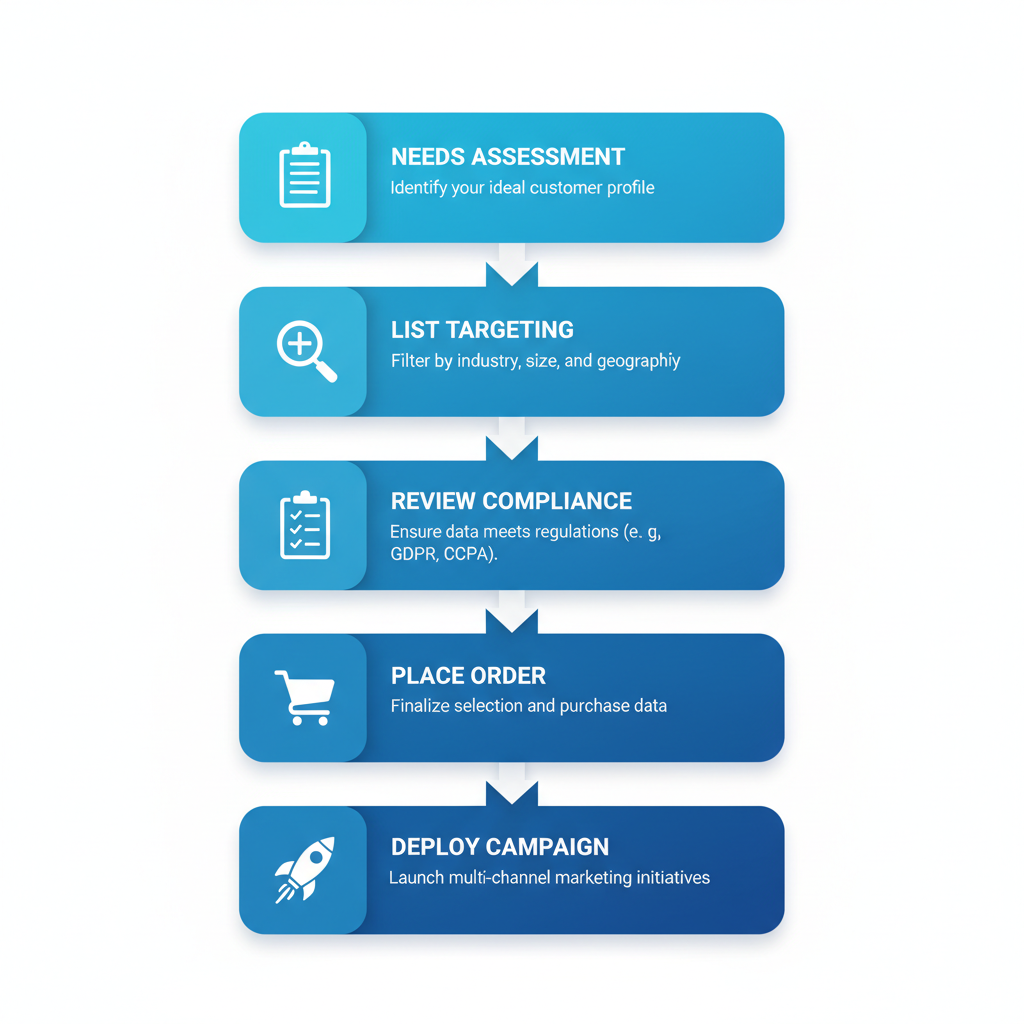
Step-by-step vertical flowchart for purchasing B2B marketing lists
The following table compares practical provider strategies, highlighting ease of acquisition and deployment:
| Strategy | ListGiant-Style | Competitor Average |
|---|---|---|
| Purchase Process | Online portal, instant counts, free samples | Manual quotes, delayed samples |
| Deployment Integration | Email deployment, social targeting, analytics | Basic email only |
| ROI Tools | A/B testing, reporting, 95% deliverability | Limited tracking, 80-90% deliverability |
Portals like these offer significant time savings, allowing quick iteration on campaigns.
Implementing Campaigns with Purchased Data
Once acquired, integrate data into multi-channel efforts for optimal engagement. Start with list hygiene to remove invalid contacts, boosting deliverability to 95% as seen in US campaign benchmarks from B2B email providers.
For email campaigns, upload lists to platforms supporting marketing list services for automated sends. Segment by industry, such as landscaping prospects, and launch with subject lines tested for open rates. Direct mail requires printing personalized pieces, while telemarketing benefits from appended phone data--always include opt-out options.
Incorporate A/B testing: Send variants to 20% of the list, comparing metrics like click-through rates. Campaign list deployment shines in omni-channel setups, like pairing email with social targeting. Analytics tools track real-time performance, with tips like timing sends mid-week for higher responses in B2B contexts.
Why this matters: Proper execution, drawing from provider guides, can yield 20-30% response improvements, directly answering how to choose the best B2B data providers for sales leads.
Measuring ROI and Optimizing Future Buys
Track success through key metrics to refine strategies. Calculate ROI with formulas like (Revenue from Conversions - Campaign Cost) / Cost, using open rates (aim for 25%), click-throughs (5-10%), and conversions from tracked links.
Analyze costs: A 10,000-contact list at 0.25 USD each totals 2,500 USD; factor in deployment fees for full picture. US examples show landscaping campaigns achieving 15% ROI via precise targeting, per B2B guides quoting average costs and benchmarks.
- Gather Data: Use built-in reporting for bounces, opens, and sales attribution.
- Evaluate Performance: Compare against goals--if conversions lag, assess list quality.
- Adjust for Next Time: Suppress underperformers and refine selects, like adding behavioral data.
Caution overbuying by starting small. Optimization here paves the way for advanced tactics, enhancing long-term efficiency.
Advanced Techniques in List Management
Marketing List Providers in the US offer sophisticated tools that transform basic list management into powerful B2B campaign engines. For expert marketers, advanced US list optimization involves leveraging AI and compliance frameworks to maximize reach and minimize risks. These techniques go beyond simple segmentation, focusing on data-driven precision from reliable sources like B2B data providers.
Key advanced techniques include:
- Lookalike Modeling: Using AI to build audiences from 250+ data sources, identifying prospects similar to high-value customers with 95% accuracy guarantees.
- Privacy Compliance: Ensuring adherence to Daniels Law, CPRA, and CCPA through automated suppression and opt-out workflows, avoiding costly violations highlighted in industry warnings.
- Analytics Integration: Combining ROI reporting, A/B testing, and multi-channel tracking to refine campaigns in real-time.
These methods provide immense value for sophisticated users, enabling precise targeting that boosts conversion rates by up to 30% according to advanced B2B reports.
| Advanced Tool | Provider Capabilities | Competitor Gaps |
|---|---|---|
| Lookalike Modeling | AI-driven audience building from 250+ sources | Basic profiling only |
| Privacy Compliance | CCPA, Daniels Law, full suppression | CAN-SPAM minimal |
| Analytics Integration | ROI reporting, A/B, multi-channel tracking | Email-only metrics |
The table illustrates how leading providers outpace competitors in enrichment and compliance, directly enhancing campaign performance. Gaps in basic tools can slash ROI by 40%, as limited analytics fail to capture cross-channel insights, leading to inefficient spends.
In practice, consider a US nonprofit seeking donors: Apply lookalike modeling to profile past contributors, then layer sophisticated data enrichment for behavioral selects. For industry targeting, such as landscaping email lists, integrate social segments for A/B testing email versus direct mail. Custom pricing for large orders--often $0.10-$5 per contact--scales efficiently via private portals for ongoing management. This approach addresses queries on costs from B2B data providers, where advanced tiers justify premiums through superior deliverability and measurable outcomes, guiding buyers to reliable sales lead providers.
Common Questions on Marketing List Providers
When exploring Marketing List Providers in the US, businesses often seek clarity on key aspects. This US list FAQs section addresses common concerns for B2B marketers, drawing from reliable practices to build confidence in data purchases.
What is the typical deliverability rate for email lists from providers?
Lists from reputable B2B data providers achieve 95%+ deliverability through regular hygiene and verification, ensuring messages reach inboxes effectively.
How much does it cost to buy targeted email lists?
Pricing ranges from $0.10 to $5 per contact, depending on targeting depth. ListGiant offers competitive rates for customized B2B segments.
Are marketing lists legal to use in the US?
Yes, compliant providers adhere to CAN-SPAM and CCPA regulations, providing opt-out options and sourced data to avoid violations.
How can I ensure list reliability for targeting?
Select providers with updated databases like ListGiant's 280 million consumer records, using demographic and behavioral filters for precise B2B outreach.
R
Where to buy targeted email lists for effective campaigns?
Choose established US providers offering samples and analytics, such as ListGiant, to test and optimize your marketing efforts.
Key Takeaways for Selecting US List Providers
Selecting the right Marketing Data Lists Providers is essential for B2B success, recapping key evaluation criteria like 95%+ accuracy guarantees, precise targeting options, and multi-channel ROI potential. Reinforce US compliance to mitigate risks, while highlighting providers like ListGiant with intuitive portals and robust guarantees.
- Top B2B data providers deliver segmented leads that drive higher conversions and efficient sales pipelines.
- Strategic benefits include enhanced engagement and measurable growth from reliable, compliant data sources.
With these insights, make optimal US list choices that align with your goals--buy a targeted email list from trusted partners like ListGiant and launch your next campaign with confidence today.
Key Takeaways for Selecting US List Providers
Selecting the right Marketing Data Lists Providers is essential for B2B success, recapping key evaluation criteria like 95%+ accuracy guarantees, precise targeting options, and multi-channel ROI potential. Reinforce US compliance to mitigate risks, while highlighting providers like ListGiant with intuitive portals and robust guarantees.
- Top B2B data providers deliver segmented leads that drive higher conversions and efficient sales pipelines.
- Strategic benefits include enhanced engagement and measurable growth from reliable, compliant data sources.
With these insights, make optimal US list choices that align with your goals--buy a targeted email list from trusted partners like ListGiant and launch your next campaign with confidence today.