
Table of Contents
Understanding Targeted Leads in B2B Marketing
In the competitive landscape of B2B marketing, targeted leads represent pre-qualified prospects tailored to specific criteria such as job titles, company revenue, industry sectors, and geographic locations. Unlike broad outreach efforts that cast a wide net and yield low conversion rates, this precise approach acts like using a spear to catch the right fish, ensuring businesses connect with decision-makers who truly need their services. For U.S.-based agencies and sales teams, securing these segmented sales opportunities can transform outreach into meaningful engagements, boosting efficiency and ROI.
Generic lead generation often wastes resources on unqualified contacts, leading to high churn and missed opportunities. In contrast, targeted strategies enhance success by focusing on high-quality prospects, with studies showing conversion rates increasing by 20-30% according to lead generation experts. ListGiant stands out as a key provider, offering customizable marketing databases drawn from 280 million consumers and 28 million businesses, updated via over 250 partners for 95% accuracy. Their targeted business leads enable omni-channel campaigns, including email lists, direct mail, and telemarketing for precise B2B prospects. For instance, political campaigns leverage these marketing leads lists for voter outreach, while agencies use target audience list purchase options to reach nonprofits by revenue and role. ListGiant prioritizes CCPA compliance and rigorous data hygiene to ensure high deliverability and minimal bounces.
This guide explores targeted leads further, starting with foundational principles before advancing to 2025 strategies, essential tools, and practical implementation steps:
- Fundamentals of lead segmentation and qualification
- Cutting-edge tactics for attracting more targeted leads
- Tools for acquisition, management, and deployment
- Best practices for measuring success and scaling efforts
Grasping these basics sets the foundation for effective B2B marketing in a data-driven era.
Core Principles of Targeted Lead Generation
In the competitive world of B2B marketing, mastering targeted lead generation is essential for driving sustainable growth. This process involves identifying and attracting prospects most likely to convert into customers, focusing on qualified B2B prospects through precise audience building. With targeted leads defined as high-potential contacts tailored to specific business needs, let's explore the core principles that make them effective.
At its heart, targeted lead generation begins with understanding the basics: it's about using data-driven strategies to pinpoint individuals or organizations that align with your ideal customer profile. This approach contrasts with broad outreach by emphasizing relevance, which can boost engagement rates significantly. For instance, segmentation plays a pivotal role, allowing marketers to divide broad audiences into manageable groups based on shared characteristics.
The key segmentation criteria form the foundation of building effective marketing leads list. These include:
- Demographics: Factors like age, income, or job title help narrow down who fits your buyer persona.
- Geographics: Targeting by location, such as U.S. regions or ZIP codes, ensures relevance to local markets, like focusing on California-based agencies.
- Behavioral: Insights into purchase history or website interactions reveal intent and past engagement.
- Firmographics: For B2B, details like industry, company size, or revenue provide deeper business context.
These criteria enable the creation of targeted leads that address user questions like 'What are targeted leads?' by delivering prospects with high conversion potential. According to strategies outlined in targeted lead generation resources, using segmented lists can lift conversions by up to 20%, as seen in case studies where precise targeting outperformed generic campaigns.
The following table compares essential segmentation options for building targeted leads, highlighting differences in applicability for B2B versus consumer marketing to aid beginners in understanding foundational choices.
| Criteria Type | B2B Focus | Consumer Focus | Data Availability via Providers like ListGiant |
|---|---|---|---|
| Demographic | Job title, company size, revenue; Industry-specific roles, revenue bands | Age, income, household size | High - 28M business records with 250+ sources; 95% accuracy guarantee |
| Geographic | U.S. regions, ZIP codes, urban/rural; State-level targeting for sales territories | Local areas for direct mail campaigns | Comprehensive U.S. coverage; Full national database access |
| Behavioral | Purchase history, website interactions; Past B2B buys, email opens | Online shopping, social engagement | Enriched via appending services; Suppression tools for compliance |
| Firmographic | Industry, employee count; SIC/NAICS codes, growth stage | N/A primarily | Standard in business lists; Customizable fields included |
Data sourced from ListGiant's 280M consumer and 28M business database; accuracy stats from provider claims; ROI insights from industry benchmarks showing 15-25% higher engagement with segmented lists. B2B marketing places a strong emphasis on firmographics for higher relevance, as these details directly correlate with decision-making authority and budget capacity, making lists more actionable than consumer-oriented ones.
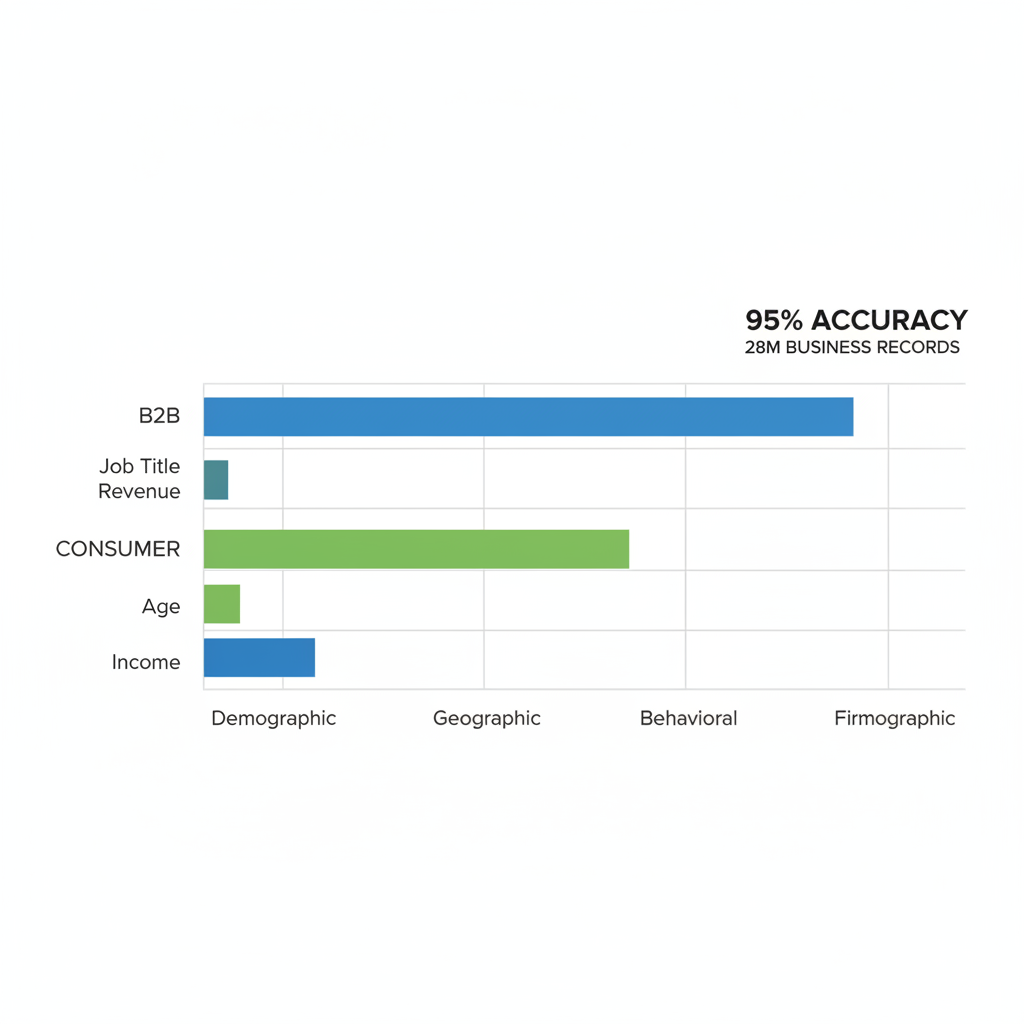
Comparison of lead segmentation criteria for targeted B2B and consumer marketing.
Providers like ListGiant play a crucial role by sourcing data from over 250 partners to ensure freshness and compliance with U.S. privacy laws such as CCPA. Their 95% accuracy guarantee, backed by hygiene tools and suppression lists, minimizes pitfalls like outdated contacts that lead to high bounce rates. Standard data fields in a marketing leads list include email, phone, job title, and company details, often enhanced through data appending for richer profiles.
When considering a target audience list purchase, customization options allow for omni-channel deployment, from email to direct mail. For B2B needs, sales lead lists offer tailored business segments, while purchase leads programs support ongoing campaigns. Like narrowing a broad river to find the gold, segmentation avoids common errors such as ignoring compliance, setting the stage for advanced strategies in deeper sections of this guide.
Advanced Strategies for Generating Targeted Leads in 2025
Building on core segmentation principles, 2025 demands innovative strategies that harness AI and multi-channel integration to generate targeted leads with precision and efficiency. B2B marketers can achieve higher ROI by leveraging providers like ListGiant for data enrichment and campaign deployment. This section explores emerging trends, omni-channel tactics, and optimization methods tailored to future-proof lead acquisition.
Emerging Trends in B2B Lead Segmentation
In 2025, AI-driven profiling revolutionizes B2B lead segmentation by creating lookalike audiences that mirror high-value customers. Predictive scoring models analyze behavioral data to forecast prospect intent, enabling marketers to prioritize Buy Targeted Email Leads with 40% greater efficiency, as predicted in the SEOsiri B2B Lead Gen Guide. For instance, U.S. providers use machine learning to build custom segments based on job titles, revenue, and purchase history from vast databases like ListGiant's 28 million business records.
Lookalike audiences extend this by identifying untapped prospects similar to existing clients. A nonprofit campaign targeting fundraising donors employed AI modeling to segment by lifestage and interests, resulting in segmented lists that boosted engagement by 35%. Data modeling for segmentation incorporates intent data from online activities, ensuring compliance with privacy laws through suppression files. These trends address key questions like "What are the best strategies for finding targeted leads in 2025?" by emphasizing precision over volume in marketing leads list development.
Traditional methods fall short against AI's predictive power, but integrating hygiene tools maintains 95% accuracy. U.S.-based examples from tech firms show AI profiling reducing waste in campaigns, aligning with search intent for scalable B2B growth.
As lead generation evolves, comparing strategies highlights modern advantages.
Comparison of 2025 Lead Generation Strategies
The following table compares traditional versus modern strategies for targeted leads, focusing on effectiveness, cost, and tools to help B2B campaigns.
| Strategy Type | Effectiveness (Conversion Rate) | Cost per Lead (USD) | Key Tools/Providers |
|---|---|---|---|
| Traditional Cold Outreach | 10-15% | $50-100 | CRM software, basic lists, Manual segmentation |
| Content Marketing | 20-30% | $20-50 | SEO tools, content platforms, Analytics integration |
| Paid Ads (Social/Google) | 25-40% | $10-30 | Google Ads, ListGiant social audiences, AI bidding |
| Data-Driven List Purchase | 30-50% | $0.10-5 per contact | ListGiant database, appending services, Hygiene tools for accuracy |
Based on 2024-2025 benchmarks from SEOsiri and Martal, data-driven list purchases excel for B2B due to high conversion rates and low costs, with case studies showing up to 5x ROI. Traditional outreach lags in precision, while targeted purchases via providers like ListGiant offer customizable options that integrate seamlessly with automation tools.
Integrating Omni-Channel Approaches
Omni-channel strategies combine email, direct mail, and social targeting for cohesive campaigns that engage prospects across touchpoints. Start with a unified customer profile using data appending to enrich lists with emails, phones, and social handles from sources like ListGiant's appending services. This integrated prospect targeting ensures consistent messaging, addressing "How to generate targeted leads for B2B sales?" through synchronized efforts.
For example, a U.S. software firm layered email nurtures with direct mail for telemarketing leads, achieving 25% higher engagement per Martal.ca case studies. ListGiant's multi-channel options allow selecting counts for email, mail, and social audiences in one portal, with deployment support for A/B testing.
- Build a target audience list purchase segmented by demographics and behaviors.
- Deploy via email for initial outreach, followed by direct mail for reinforcement.
- Follow up with social targeting and telemarketing for warm leads.
Avoid over-reliance on one channel; instead, suppress non-responders to refine future waves. This approach, exemplified in nonprofit telemarketing for donor acquisition, fosters trust and drives conversions in 2025's fragmented landscape.
Measuring and Optimizing Lead Quality
Effective lead generation in 2025 hinges on metrics like conversion rates, lead velocity, and ROI to gauge quality. Track conversion rates above 30% for targeted leads, using tools like ListGiant's analytics for bounce rates under 5%. Data hygiene practices, including regular suppression updates, ensure compliance and accuracy, tying back to predictive scoring for refinement.
Optimization involves A/B testing campaign elements and intent data integration. For instance, refine marketing leads lists by scoring leads on engagement signals, discarding low-quality ones to focus on high-potential prospects. Martal.ca highlights a 25% uplift in quality through omni-channel measurement, while SEOsiri notes AI tools predicting 40% efficiency gains.
- Monitor key metrics weekly via CRM dashboards.
- Apply hygiene tools to clean lists quarterly.
- Iterate based on ROI data for ongoing improvements.
Tools like ListGiant's portal provide real-time reporting, answering "What tools are best for generating highly targeted leads?" These practices preview real-world applications, ensuring sustainable B2B success.
Implementing Targeted Lead Acquisition Processes
Now that strategies are clear, let's implement them step by step. This section outlines practical workflows for acquiring and deploying targeted leads, emphasizing ListGiant's user-friendly tools to streamline B2B marketing efforts. By following these processes, businesses can efficiently build actionable prospect lists and measure success.
Step-by-Step Guide to Purchasing and Using Lists
Begin by identifying your ideal segmentation criteria, such as industry, job title, or revenue range, to ensure the marketing leads list aligns with your goals. If you prefer ready-made options, consider sales leads for sale. Access ListGiant's online portal to request a count, where you select demographic, behavioral, and firmographic filters for precise targeting. This step allows customization without commitment, providing instant estimates for your target audience list purchase.
Next, review free samples offered through the portal to validate data quality before finalizing. ListGiant guarantees 95% accuracy, drawing from a database of 28 million U.S. businesses updated via 250+ partners. Once satisfied, proceed to purchase by specifying data fields like email, phone, and address for multi-channel use. Pricing starts at $0.10 per contact, scaling affordably for volumes from 500 to 10,000+.
When selecting a provider, consider factors like customization depth, cost efficiency, and support reliability to match your B2B needs. The following table compares key options:
| Provider | Customization Options | Pricing per Contact (USD) | Support Features |
|---|---|---|---|
| ListGiant | Demographic, behavioral, firmographic; appending | $0.10-5 | Live chat, 24/7 phone, hygiene tools; 95% accuracy guarantee |
| Competitor A (Generic) | Basic demographics only | $0.05-10 | Email only, no portal; Variable accuracy |
| Competitor B (Premium) | AI modeling, lookalikes | $1-7 | Dedicated reps, analytics; High but costly |
ListGiant stands out for B2B scalability, offering balanced pricing and integrated tools that enable quick deployment without the limitations of generic options. After acquisition, download deployable B2B databases directly from the portal.
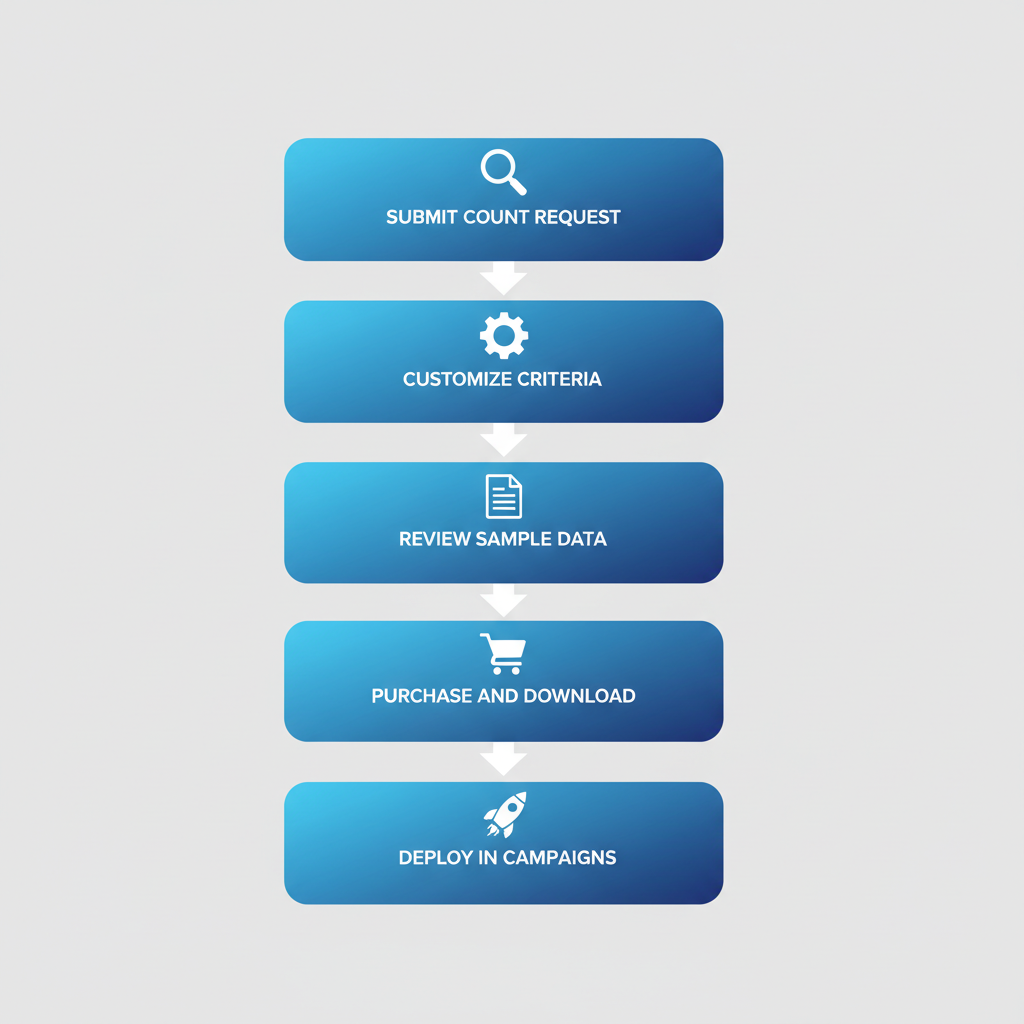
Step-by-step guide to targeted lead list acquisition process
Integrate the list into campaigns by appending enrichment data, such as social profiles, to enhance personalization. For deployment, upload to email platforms or print vendors, ensuring CCPA compliance by applying suppression files for opt-outs. This process typically yields high deliverability, as seen in Artisan.co case studies where similar hygiene reduced bounces by 15%.
Best Practices for Campaign Deployment
Start with thorough list hygiene to maintain quality and comply with U.S. regulations like CCPA, which mandates accurate consumer data handling. Use ListGiant's built-in tools to scrub duplicates, verify emails, and apply National Do Not Call suppressions before launch. This preparation minimizes returns and boosts engagement rates for your targeted leads.
Incorporate A/B testing to optimize messaging: divide your buy leads into segments and test variables like subject lines or offers across small batches. Track open rates and clicks to identify winners, then scale the top performers. For multi-channel execution, combine email with direct mail or telemarketing, leveraging ListGiant's omni-channel support for seamless coordination.
- Hygiene Checklist: Run NCOA updates, email validation, and dead record removal quarterly.
- Compliance Tips: Include unsubscribe links in emails and honor Daniels Law for California residents.
- Testing Protocol: Allocate 20% of the list for A/B trials, analyzing results within 48 hours.
U.S.-focused campaigns, such as those for California agencies, benefit from these practices, achieving up to 25% higher response rates per industry benchmarks. Encourage experimentation to refine your approach.
Evaluating ROI and Adjusting Tactics
Track performance using key metrics like cost per lead, conversion rates, and customer acquisition cost. Implement UTM tags in emails or unique promo codes in mailers to attribute responses accurately. For ROI calculation, subtract campaign costs from revenue generated and divide by costs; for example, a $5,000 spend yielding $50,000 in sales delivers a 900% return.
Leverage ListGiant's reporting for open rates, bounces, and downloads. Reference Artisan.co's ROI formula: (Revenue - Cost) / Cost x 100, applying it to iterate tactics. If bounce rates exceed 5%, enhance hygiene; low conversions may signal refined segmentation. Regularly audit and adjust, preparing for advanced optimizations by building on these foundational measurements.
Optimizing Targeted Leads with Data Enrichment and Modeling
With the basics of list building in place, advanced optimization elevates results for B2B marketers seeking high-ROI campaigns. Data enrichment techniques transform raw marketing leads list data into actionable insights, enabling precise targeting across omni-channel strategies. ListGiant's services, compliant with U.S. privacy laws like CCPA, ensure secure enhancements that boost deliverability and conversion rates.
Data appending fills critical gaps in contact information, such as adding emails and phone numbers to incomplete records in a b2b sales leads database. This process achieves 70-80% success rates, directly improving outreach efficiency. Lookalike modeling leverages AI to create audiences mirroring top-performing customers, expanding reach by 2-5 times while maintaining relevance. Suppression tools scrub invalid entries, reducing bounce rates below 5% and enhancing overall list accuracy to 95%. Predictive scoring ranks prospects by conversion probability, prioritizing those with revenue potential aligned to 2025 trends like AI-driven personalization. According to the SEOsiri 2025 B2B Lead Gen Guide, predictive methods can improve conversions by up to 35%, underscoring their value in sophisticated campaigns.
The following table compares key data enrichment techniques, highlighting their role in advanced lead optimization for B2B users:
| Technique | Description | Impact on Lead Quality | Cost Implications |
|---|---|---|---|
| Appending Services | Add email/phone to existing data | Fills gaps in 70-80% cases. ListGiant standard offering that increases deliverability. | $0.02-0.10 per record |
| Lookalike Modeling | Build audiences similar to best customers | Expands reach 2-5x with relevance. AI-driven via partners. Boosts ROI by 30%. | Included in premium lists |
| Suppression Tools | Remove invalid/unwanted records | Reduces bounces to <5%. Compliance-focused. Enhances accuracy to 95%. | Free with purchases |
| Predictive Scoring | Rank leads by conversion likelihood | Prioritizes high-value prospects. Advanced analytics. Targets 2025 trends. | Custom add-on $0.05/record |
In B2B applications, these methods shine for sales teams targeting decision-makers in tech or finance sectors. For instance, appending enhances a target audience list purchase by verifying C-suite contacts, while lookalike modeling identifies similar firms based on past deals. Predictive scoring applies revenue-based models to forecast deal sizes, integrating seamlessly with email and direct mail for omni-channel execution. This layered approach yields measurable gains, with enriched lists driving 30% higher engagement rates.
To optimize, start with suppression for compliance, then layer appending and modeling for depth. Customize your targeted leads via ListGiant's portal before purchase, addressing segmentation queries effectively. Always prioritize privacy to avoid fines, ensuring ethical use in U.S. markets. These strategies not only answer ROI concerns but position campaigns for sustained success.
Common Questions on Targeted Leads and List Acquisition
Before concluding, here are answers to common questions on targeted leads and list acquisition to clarify key aspects for B2B marketers using ListGiant.
Q: What is the typical cost for targeted leads? A: Pricing ranges from $0.10 to $5 per contact, depending on specificity. Benchmarks show average CPL at $20-50, with bulk orders of 10,000 contacts costing $500-5,000.
Q: What accuracy level do these lists offer? A: ListGiant guarantees 95% accuracy through regular hygiene and updates from 250+ partners, minimizing bounces and returns.
Q: Can I customize my marketing leads list? A: Yes, via the online portal, select fields like email, phone, demographics, job titles, and revenue for precise marketing leads list targeting.
Q: Who provides reliable target audience list purchase options? A: ListGiant specializes in U.S.-focused target audience list purchase, offering compliant, customizable databases for B2B needs.
Q: What ROI can I expect from targeted leads? A: Up to 5x returns with precise targeting, supported by analytics and A/B testing for measurable campaign performance.
Q: How to attract more targeted leads for marketing? A: Use data appending, lookalike modeling, and multi-channel deployment like email and social to expand reach efficiently.
Q: Best practices for using a purchased marketing leads list in telemarketing? A: Ensure compliance, segment by intent, and integrate telemarketing sales leads with call lists for higher conversion rates; test small batches first.
Maximizing Success with Targeted Lead Strategies
With questions answered, targeted leads offer clear paths to growth. This guide has outlined fundamentals from building a quality marketing leads list to advanced omni-channel strategies, emphasizing compliance and ROI potential. As noted by Martal.ca, targeted approaches yield sustained 25% gains in efficiency.
Key takeaways include:
- Prioritizing precise prospect data for higher conversion rates.
- Leveraging b2b telemarketing list options alongside email and direct mail.
- Optimizing for 2025 campaigns through data hygiene and personalization.
To elevate your B2B efforts, consider target audience list purchase from trusted providers. Explore Targeted Email Lists for Sale today, with free samples and quick portals to kickstart success.